

SUPREME COURT SHOWDOWN: AR-15 BANS, NEW FIREARMS RULINGS & MONTANA’S 2027 HUNTING DECISIONS
SUPREME COURT SHOWDOWN: AR-15 BANS, NEW FIREARMS RULINGS & MONTANA'S 2027 HUNTING DECISIONS
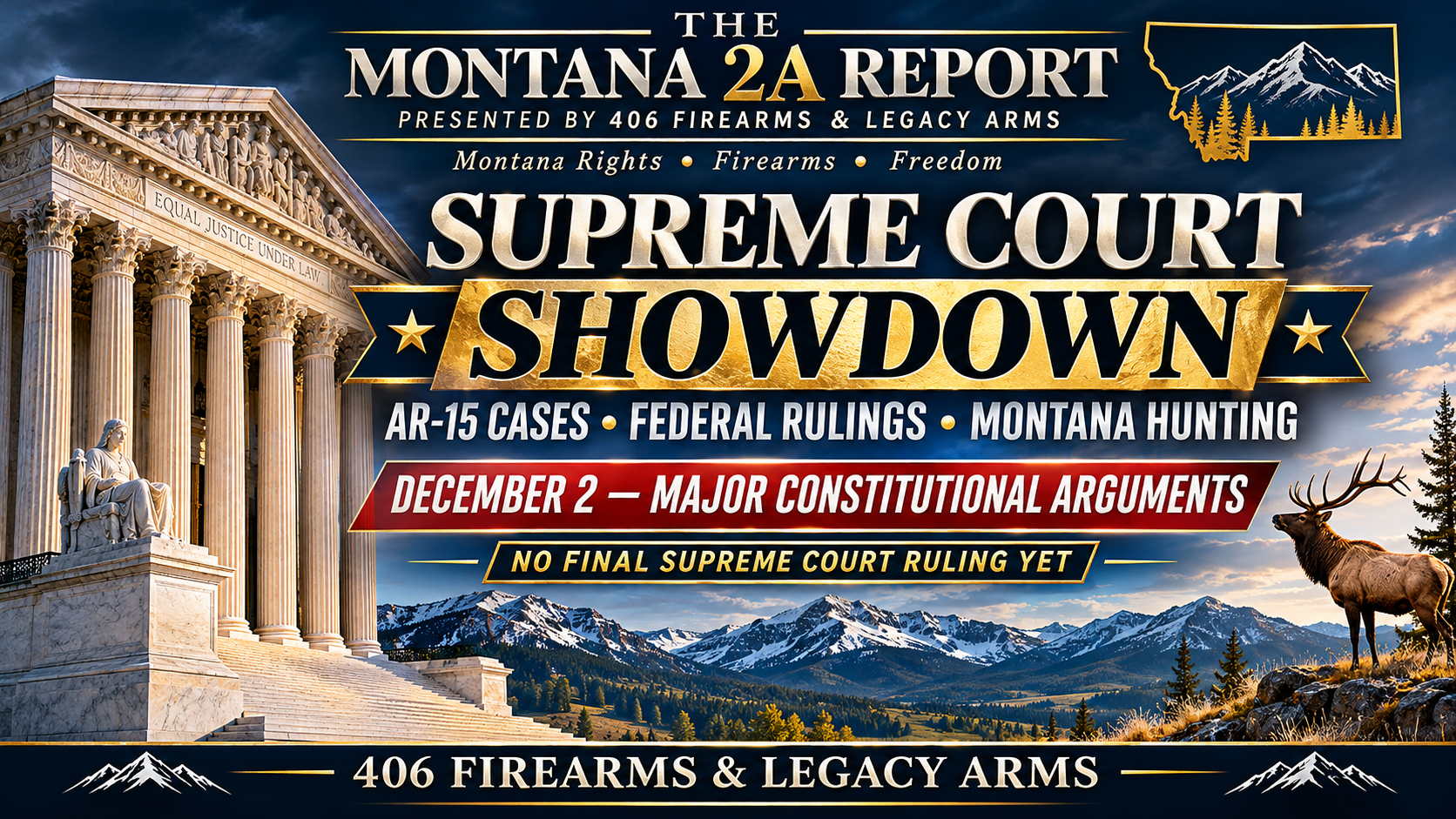
- The November 13, 2026, edition of The Montana 2A Report examines a major constitutional showdown approaching at the United States Supreme Court. The justices are scheduled to hear consolidated challenges involving restrictions on commonly owned semiautomatic rifles on December 2. New procedural filings have raised questions about one of the cases, while the Court's November 9 orders declined review in numerous other firearms-related disputes. A federal district court also dismissed a Justice Department challenge to Maryland firearm-carry restrictions without deciding the underlying constitutional question. In Montana, Fish, Wildlife & Parks is considering 2027 hunting-season proposals, including an amendment with a November 18 public comment deadline. Northwest Montana hunters also face important chronic wasting disease sampling requirements during the ongoing general hunting season. The report additionally reviews ATF's changed National Firearms Act enforcement policy, continuing Montana-law concerns, and practical considerations for licensed firearms businesses. Presented by 406 Firearms & Legacy Arms, this weekly edition separates established legal decisions, pending cases, regulatory proposals, and continuing compliance obligations.
SUPREME COURT SHOWDOWN: AR-15 BANS, NEW FIREARMS RULINGS & MONTANA'S 2027 HUNTING DECISIONS
THE MONTANA 2A REPORT
Weekly Flagship Edition — November 13, 2026
Prepared for publication November 16, 2026
Presented by 406 Firearms & Legacy Arms
Montana Rights • Firearms • Freedom
THE BIG STORY: AMERICA’S NEXT MAJOR SECOND AMENDMENT SHOWDOWN IS APPROACHING
The United States Supreme Court is preparing to hear arguments in two major constitutional challenges involving restrictions on commonly owned semiautomatic rifles.
At the same time, a new procedural dispute threatens to complicate one of those cases, the Court has declined to review numerous other firearms-related challenges, and federal judges continue examining the limits of government authority over firearm possession and carrying.
Meanwhile, here in Montana, Fish, Wildlife & Parks is considering changes affecting the 2027 hunting seasons, and Northwest Montana hunters have immediate responsibilities involving current hunting regulations and chronic wasting disease.
And for federally licensed firearms dealers, the changing legal treatment of suppressors and other National Firearms Act items continues to create questions that demand careful attention.
There is a great deal happening.
But understanding the difference between a court agreeing to hear a case, issuing a final decision, and declining to review a case has never been more important.
Here is what actually happened during the week of November 7–13, what remains undecided, and what Montana gun owners should be watching next.
1. SUPREME COURT PREPARES TO CONSIDER BANS ON COMMONLY OWNED SEMIAUTOMATIC RIFLES
One of the most consequential Second Amendment cases currently before the Supreme Court concerns a question that has been debated in federal courts for years:
Does the Second Amendment protect the possession of commonly owned semiautomatic rifles, including the AR-15 platform?
The Supreme Court has agreed to review two consolidated cases:
- Viramontes v. Cook County, No. 25-238.
- Grant v. Higgins, No. 25-566.
The Court granted review on June 30, 2026, and scheduled oral arguments for December 2.
The lawsuits challenge restrictions involving semiautomatic rifles in Cook County, Illinois, and Connecticut.
The central constitutional question concerns whether those firearms are protected by the Second and Fourteenth Amendments.
The petitioners contend that commonly owned rifles used for lawful purposes fall within the Second Amendment’s protections.
Government officials defending the restrictions argue that the laws are permissible public-safety measures and that governments possess authority to restrict particular categories of weapons.
The Court must evaluate those arguments under its existing Second Amendment precedents, including District of Columbia v. Heller, McDonald v. Chicago, New York State Rifle & Pistol Association v. Bruen, and subsequent decisions.
Why These Cases Matter
For decades, courts have examined how far governments may go when regulating the possession of specific firearms.
The Supreme Court has recognized an individual right to keep and bear arms, but it has also acknowledged that constitutional protections are not unlimited.
The dispute involving commonly owned semiautomatic rifles raises questions about how those principles apply to modern firearms.
One argument focuses on whether a firearm is commonly possessed for lawful purposes.
Another concerns the relevance of historical firearms regulations and whether modern restrictions have sufficiently similar historical predecessors.
There are also disagreements over how courts should evaluate the characteristics of particular firearms.
The outcome could influence litigation involving state and local restrictions across the country.
But it is essential to understand that the Court has not issued a final ruling in these cases.
The cases are scheduled for argument.
Nothing in the Court’s decision to hear them should be interpreted as a prediction that either side will prevail.
A New Procedural Fight Arrived Before the Arguments
During the week leading up to this report, the litigation became more complicated.
On October 29, petitioner Cutberto Viramontes requested dismissal from his case.
On November 5, Cook County filed a suggestion that the case had become moot.
The county’s position raises a procedural question about whether the remaining parties and circumstances continue to support the Court’s review.
On November 11, the petitioners responded.
On November 13, Cook County submitted an additional reply.
These developments appear on the official Supreme Court docket.
Why does this matter?
Because federal courts generally decide actual cases and controversies. A court may need to address whether the dispute remains properly before it before reaching the underlying constitutional question.
However, the consolidated Connecticut case, Grant v. Higgins, remains part of the Supreme Court’s review.
The Court’s published calendar continues to identify December 2 for oral argument.
The United States Also Has a Role
On November 9, the Supreme Court granted the Solicitor General’s motion to participate in oral argument as amicus curiae, with divided argument time.
That is a procedural development, not a decision on the constitutional merits.
It means the federal government will have a formal opportunity to present its position during oral argument.
The Court’s eventual decision will depend on its consideration of the constitutional arguments, legal precedent, factual record, and procedural questions.
What Montana Gun Owners Should Understand
Montana does not have a general statewide prohibition on ordinary AR-15-style semiautomatic rifles comparable to the restrictions being challenged in these cases.
That does not make the litigation irrelevant.
A Supreme Court decision interpreting the constitutional protection afforded to commonly owned rifles could influence future legislation and litigation nationwide.
It could also affect how lower courts analyze restrictions involving similar firearms.
For residents who travel or relocate, the legal landscape remains particularly important.
Firearm ownership that is lawful in Montana does not automatically mean identical conduct is lawful in every other state.
State and local restrictions remain enforceable unless suspended, overturned, or otherwise invalidated through applicable legal processes.
The next major date is December 2, 2026.
That is the scheduled argument date—not the date of a guaranteed final decision.
Official sources:
Supreme Court — Viramontes v. Cook County, No. 25-238
Supreme Court — Grant v. Higgins, No. 25-566
2. SUPREME COURT DECLINES TO HEAR NUMEROUS FIREARMS-RELATED CASES
On November 9, the Supreme Court issued orders declining to review numerous firearms-law petitions.
According to the Duke Center for Firearms Law’s November 9 tracking report, the Court denied review in 22 firearms-related petitions.
Sixteen involved challenges to federal or state restrictions on firearm possession by people with certain criminal convictions.
Other petitions concerned different issues, including firearm possession while under indictment, restrictions affecting noncitizens, waiting periods, and certain state firearm-possession prohibitions.
This was an important development, but it requires careful interpretation.
What Does It Mean When the Supreme Court Denies a Petition?
The Supreme Court receives far more requests for review than it can hear.
When it denies a petition for a writ of certiorari, it ordinarily means the Court has decided not to review that case.
A denial of certiorari does not establish that the Supreme Court agrees with the lower court’s reasoning.
It also does not produce a new nationwide constitutional ruling resolving every related legal question.
The lower-court judgment generally remains in effect for that case.
The distinction matters because social-media coverage often describes a denial of review as if the Supreme Court had issued a full opinion endorsing a particular firearm restriction.
That is not what happened.
The Debate Over Prohibited-Person Restrictions
One recurring issue involves 18 U.S.C. § 922(g)(1), the federal statute generally prohibiting firearm possession by individuals convicted of crimes punishable by imprisonment exceeding one year, subject to the law’s definitions and exceptions.
Litigants have challenged the provision in different ways.
Some argue that categorical restrictions are inconsistent with the Second Amendment’s historical protections.
Others contend that the federal government has constitutional authority to disarm individuals whose criminal convictions demonstrate relevant public-safety concerns.
Federal appellate courts have considered facial challenges, which seek to invalidate a law generally, and as-applied challenges, which contest its constitutionality in particular circumstances.
Those challenges do not necessarily present identical legal questions.
The Supreme Court’s November 9 denials did not resolve the entire debate.
What This Means at the Gun Counter
For licensed dealers, prohibited-person restrictions remain serious legal requirements.
A denied petition does not create a new exemption.
A pending constitutional challenge does not automatically suspend federal law.
Customers and dealers should not assume that a statute has changed simply because a lawsuit has been filed.
The practical lesson is that constitutional litigation and transaction compliance operate on different timelines.
A legal challenge may eventually produce significant changes.
Until that happens, applicable law, binding court orders, and official guidance must be evaluated carefully.
Source:
Duke Center for Firearms Law — SCOTUS Gun Watch, November 9, 2026
3. FEDERAL COURT DISMISSES JUSTICE DEPARTMENT CHALLENGE TO MARYLAND CARRY RESTRICTIONS
A separate development occurred on November 9 in the U.S. District Court for the District of Maryland.
In United States v. Montgomery County, a federal judge dismissed a Justice Department lawsuit challenging local restrictions on carrying firearms in designated public areas.
The case involved Montgomery County’s law restricting firearms at or near certain public gathering places.
Those locations include categories such as parks, schools, libraries, government facilities, and other defined places of public assembly.
The restrictions generated controversy concerning the appropriate scope of government authority over public carry.
The Justice Department’s Position
The Department of Justice alleged that the county’s restrictions violated the Second Amendment.
It attempted to pursue the lawsuit under a federal civil-rights enforcement statute allowing the government to challenge certain patterns or practices of misconduct by law enforcement authorities.
The federal government argued that enforcement of the county ordinance could produce constitutional violations.
The Court’s Decision
Judge Theodore Chuang dismissed the complaint.
The court concluded that the government had not adequately alleged the pattern or practice of law-enforcement conduct required under the particular statute it invoked.
The government had challenged the anticipated enforcement of the ordinance without alleging qualifying actual enforcement conduct sufficient to support that legal theory.
This distinction is essential.
The court did not issue a final constitutional determination that the county’s firearm-carry restrictions were valid.
It dismissed the federal government’s lawsuit because the legal mechanism used to bring it was insufficient.
Why the Distinction Matters
There are two different questions in this case.
The first concerns whether Montgomery County’s restrictions are consistent with the Second Amendment.
The second concerns whether the federal government used an appropriate statutory procedure to challenge them.
The November 9 ruling principally addressed the second question.
That means the dismissal should not be described as a definitive Supreme Court-style ruling approving all sensitive-place restrictions.
Nor should it be presented as a decision eliminating the restrictions.
Other legal challenges may raise different claims or procedures.
Implications for Montana
Montana gun owners may encounter significantly different firearm-carry rules when traveling outside the state.
A concealed-carry permit, constitutional-carry provision, or lawful firearm possession in Montana does not automatically eliminate restrictions established by another jurisdiction.
Gun owners should verify the laws applicable to their destination before traveling.
For firearms businesses and instructors, the case also reinforces the importance of explaining the difference between constitutional litigation and the rules currently applicable to a particular individual.
Source:
Duke Center for Firearms Law — Second Amendment Litigation Developments, November 13, 2026
4. MONTANA’S 2027 HUNTING RULES ARE HEADING TOWARD IMPORTANT DECISIONS
While national attention is focused on federal courts, Montana hunters have their own regulatory developments to follow.
Montana Fish, Wildlife & Parks is preparing for the December 10, 2026, Fish and Wildlife Commission meeting.
Among the matters listed for consideration are proposed amendments affecting permits, quotas, quota ranges, season lengths, and hunting areas for deer, elk, antelope, and turkey in the 2027 seasons.
The initial public comment period on the principal proposal closed November 11 at noon.
However, FWP identifies a separate comment opportunity concerning Commissioner Wargo’s Amendment No. 1, running from November 13 through noon on November 18.
The commission is scheduled to consider the relevant proposals on December 10.
Why This Matters for Northwest Montana
For residents of Lincoln County and the surrounding region, changes in hunting regulations can affect far more than the number of animals taken during a season.
Hunting opportunities influence where people travel, which permits they seek, how hunting pressure is distributed, and how wildlife populations are managed.
A permit adjustment may affect access in particular hunting districts.
Changes in season structures can influence hunter participation and wildlife-management objectives.
Quota decisions can also affect how hunters plan for future seasons.
But none of those possible effects should be confused with a regulation that has already been adopted.
The listed December proposals remain proposals until the appropriate final action is taken.
The specific impact on any individual hunting district depends on the approved language.
Public Participation Matters
Hunters who want to understand the proposals should review the official materials rather than rely on summaries circulating on social media.
The FWP website provides the agenda materials, proposal documents, and information about public participation.
Comments are most useful when they identify a specific concern and provide information relevant to the proposal.
For example, local observations about wildlife distribution, access, hunting pressure, or practical implementation may be important to a regulatory discussion.
Public participation is an opportunity to provide information. It does not guarantee that the commission will adopt a particular position.
What Happens Next?
The immediate deadline associated with Wargo’s amendment is noon on November 18.
The larger commission meeting is scheduled for December 10.
Hunters should confirm current information on the official FWP website before submitting comments or relying on a proposed rule.
Official source:
Montana FWP — Public Comment Opportunities and December Commission Materials
5. DEER AND ELK SEASON CONTINUES — BUT NORTHWEST MONTANA HUNTERS FACE IMPORTANT CWD REQUIREMENTS
Montana’s 2026 general deer and elk season began October 24 and is scheduled to continue through November 29, subject to district-specific regulations.
That means November is a particularly active period for hunters throughout Northwest Montana.
It is also an important period for chronic wasting disease monitoring.
What Is Chronic Wasting Disease?
Chronic wasting disease, commonly called CWD, affects members of the deer family, including deer, elk, and moose.
It is a serious wildlife-management concern because infected animals may contribute to the spread of the disease through environmental contamination and contact with other animals.
Montana FWP uses hunter-submitted samples as part of its surveillance and management efforts.
Testing helps biologists understand where the disease is present and how its distribution may be changing.
Mandatory Testing Is Not the Same Everywhere
FWP states that CWD testing is voluntary for most hunters in Montana, but certain special licenses and permits carry mandatory sampling requirements.
For the 2026 season, FWP identifies mandatory testing for animals harvested using:
- Deer B License 199-20 in hunting districts 100, 103, and 104.
- Deer Permit 103-50 in Hunting District 103.
These requirements are especially relevant to hunting activity near Libby and in parts of Northwest Montana.
A hunter should not assume that testing rules are identical for every permit or hunting district.
Carcass Disposal Matters
FWP also emphasizes proper handling and disposal of carcass materials.
Certain tissues can contribute to environmental contamination.
The department recommends leaving specified high-risk carcass material at the harvest site where appropriate or disposing of it through authorized arrangements.
Improper dumping is both a wildlife-management and public-responsibility concern.
Hunters should consult current state guidance before transporting or disposing of carcass material, particularly when crossing state lines.
Hunting and Conservation Are Connected
Hunters provide information that wildlife managers could not easily obtain through routine field observation alone.
Harvest reporting, CWD sampling, and compliance with applicable regulations contribute to broader management decisions.
Those efforts can help inform future seasons, permit structures, and conservation programs.
For hunters in Eureka, Rexford, Libby, Troy, and neighboring areas, the practical takeaway is to review current district-specific requirements before heading into the field and to understand any testing obligation associated with the license or permit being used.
Official sources:
Montana FWP — 2026 Hunting Regulations
Montana FWP — Chronic Wasting Disease Management
6. THE NFA & FFL DESK: FEDERAL SUPPRESSOR POLICY HAS CHANGED, BUT MONTANA LAW STILL MATTERS
One of the most consequential firearms-regulatory developments of 2026 remains the federal government’s changed approach to enforcement of several National Firearms Act requirements.
On October 9, 2026, the Bureau of Alcohol, Tobacco, Firearms and Explosives issued guidance following the federal district court decision in Silencer Shop Foundation v. ATF.
The ruling and subsequent federal enforcement policy affect certain firearms and devices that have historically been regulated under the National Firearms Act.
The affected categories include silencers, short-barreled rifles, short-barreled shotguns, and certain other weapons covered by the relevant federal provisions.
However, the legal landscape remains complicated.
The Difference Between a Court Injunction and Agency Enforcement Policy
The underlying district court injunction applies to identified parties and other persons covered by its terms.
ATF subsequently announced a broader policy of enforcement discretion concerning specified NFA requirements for the affected categories.
That distinction matters.
An agency deciding not to enforce certain federal requirements is not necessarily the same as Congress repealing every relevant law.
Nor does a federal enforcement policy automatically amend state statutes.
A future court ruling, legislative change, or change in executive-branch policy could affect how these issues are handled.
General Gun Control Act Requirements Continue
ATF’s published guidance makes clear that affected items remain subject to applicable provisions of the Gun Control Act.
For federally licensed dealers, the requirements concerning eligibility, transaction records, and applicable background checks remain important.
ATF also distinguishes the affected items from machine guns and destructive devices, which remain subject to their separate statutory requirements.
The policy changes must therefore be evaluated by firearm category rather than applied indiscriminately to every regulated product.
Montana’s Legal Situation Requires Separate Attention
The Montana Department of Justice issued guidance on August 27 addressing the federal Silencer Shop Foundation decision and its relationship to Montana law.
The state guidance identifies continuing restrictions concerning unregistered silencers and certain short-barreled firearms.
It also highlights the relevance of federal registration requirements under particular Montana statutes.
That creates an important distinction for residents and licensed dealers.
A transaction that falls within a federal nonenforcement policy is not necessarily authorized under Montana law.
Federal and state requirements must be considered separately.
Why This Matters for Montana FFLs
For a licensed firearms dealer or manufacturer, regulatory changes can affect compliance programs, customer information, inventory records, and transaction procedures.
Businesses should ensure that personnel understand the applicable federal guidance, relevant state restrictions, and the difference between a legal requirement and an enforcement policy.
Questions concerning state-law compliance, registration status, and specific transactions should be addressed with current written guidance and qualified legal advice.
A change in federal policy is not a reason to abandon accurate recordkeeping.
For customers, the important message is that the legal treatment of suppressors and other historically regulated items may differ from what was required earlier in 2026, but those changes do not mean every product or transaction is completely unregulated.
Official sources:
ATF — Update to NFA Transfer Guidance
Montana Department of Justice — Guidance Following Silencer Shop Ruling
7. FACT CHECK: THREE CLAIMS THAT NEED CONTEXT
Firearms-law developments often spread rapidly across social media.
Unfortunately, simplified headlines can turn complicated legal events into inaccurate statements.
Here are three examples worth understanding.
Claim One: The Supreme Court Has Already Struck Down AR-15 Bans
Not correct as of this reporting period.
The Court has agreed to hear consolidated challenges involving restrictions on commonly owned semiautomatic rifles.
The cases are scheduled for oral argument on December 2.
The Court has not issued its final decision.
A grant of certiorari is not the same thing as a ruling on the constitutional merits.
Claim Two: The Supreme Court’s November 9 Denials Mean Every Challenged Gun Law Was Declared Constitutional
Not correct.
When the Supreme Court declines to review a petition, the denial ordinarily does not express agreement with the lower court’s reasoning.
The relevant lower-court judgments generally remain undisturbed, but a denial does not create a new nationwide ruling resolving every constitutional question raised by those petitions.
Claim Three: Suppressors and Other NFA Items Are Now Completely Unregulated
Not correct.
ATF’s October guidance describes substantial federal changes concerning specified NFA requirements.
However, the Gun Control Act continues to apply, certain other NFA categories remain fully regulated, and state laws may impose additional restrictions.
In Montana, the relationship between federal nonenforcement and existing state statutes deserves particular attention.
The overall lesson is simple: before relying on a legal headline, identify what actually changed and which requirements still apply.
8. THE WEEK AHEAD: DATES MONTANA GUN OWNERS SHOULD KNOW
Several upcoming dates deserve attention.
November 18, 2026 — Montana FWP Comment Deadline
The public comment period identified for Commissioner Wargo’s Amendment No. 1 closes at noon. Interested residents should verify the official FWP materials.
November 29, 2026 — General Deer and Elk Season
Montana’s general deer and elk season is scheduled to conclude, subject to district-specific rules and applicable exceptions.
December 2, 2026 — U.S. Supreme Court Oral Arguments
The Court is scheduled to hear the consolidated Viramontes and Grant cases concerning restrictions on commonly owned semiautomatic rifles.
December 10, 2026 — Montana Fish and Wildlife Commission
The commission is scheduled to consider proposals affecting future hunting regulations.
These events present different kinds of developments.
A public comment deadline is an opportunity for participation.
A hunting-season date identifies a regulatory period.
An oral argument is part of the judicial decision-making process.
A commission meeting may result in final administrative action.
None should be confused with a completed outcome before that outcome occurs.
THE GUN OWNER’S BOTTOM LINE
For ordinary Montana firearm owners, the week’s developments offer several practical lessons.
The Supreme Court’s pending semiautomatic-rifle cases could have significant implications for future firearms litigation, but no final decision has been issued.
The November 9 certiorari denials do not resolve the nationwide debate over prohibited-person restrictions.
The Maryland ruling demonstrates the difference between challenging the constitutionality of a law and demonstrating that a particular legal procedure authorizes a court to grant relief.
Montana’s upcoming wildlife-management decisions may influence future hunting opportunities, and public participation remains available on the identified amendment.
Current hunting-season and CWD requirements continue to matter for Northwest Montana residents.
And the changing federal approach to NFA enforcement requires careful attention to both federal and state law.
These developments illustrate why firearms owners, instructors, dealers, and community organizations benefit from relying on official documents rather than abbreviated social-media interpretations.
THE FINAL SHOT: CONSTITUTIONAL RIGHTS, LEGAL CLARITY, AND RESPONSIBLE OWNERSHIP
The Second Amendment remains one of the most closely examined constitutional provisions in American law.
Its interpretation affects individual rights, public safety, businesses, law enforcement, and governments at every level.
During this reporting week, federal litigation demonstrated how much remains unsettled.
The Supreme Court is preparing to consider important questions involving commonly owned semiautomatic rifles.
Other petitions were denied review without resolving their underlying constitutional debates.
A federal district court dismissed a firearm-carry lawsuit because of the legal mechanism used to bring it.
And licensed dealers continue navigating the consequences of major changes in federal NFA policy.
Meanwhile, Montana residents face more immediate responsibilities involving hunting regulations, conservation, and safe firearm ownership.
The relationship between constitutional protections and regulatory authority deserves serious examination.
So does the responsibility to accurately understand the law as it exists today.
The strongest public discussions distinguish legal facts from predictions, and proposed changes from completed decisions.
That approach matters whether someone is defending a constitutional argument, considering legislation, operating a federally licensed business, or heading into the Montana mountains for hunting season.
We will continue following these developments as the Supreme Court approaches its December arguments and Montana prepares for further wildlife-management decisions.
Know your rights. Understand the regulations. Respect the responsibilities.
And above all, make decisions based on verified information rather than speculation.
THE MONTANA 2A REPORT
Presented by 406 Firearms & Legacy Arms
Montana Rights • Firearms • Freedom
Veteran-Owned | 24 Years of Military Service
Legacy Arms LLC / 406 Firearms
Rexford, Montana
Editorial and Legal Disclaimer
This article provides general news reporting, constitutional analysis, and educational information. It is not legal advice.
Court decisions, agency guidance, firearm regulations, and hunting requirements may change. Readers should review current official sources and consult qualified professionals before relying on legal interpretations or conducting regulated transactions.
The article addresses developments known during the November 7–13, 2026, reporting period and was prepared for publication November 16, 2026.