

More Than 1,400 Montana Shooters Have Spoken — Now the State Is Planning What Comes Next
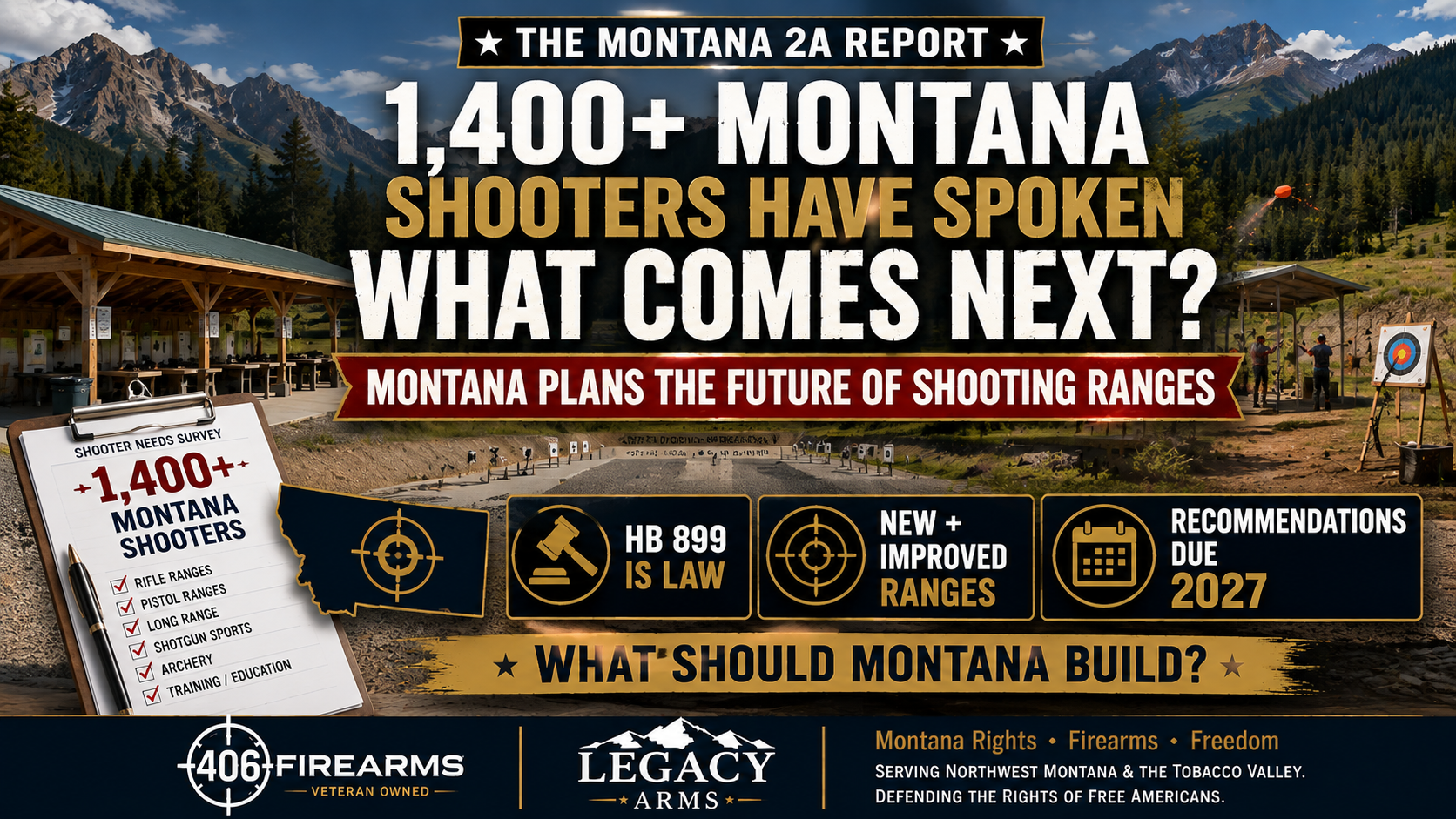
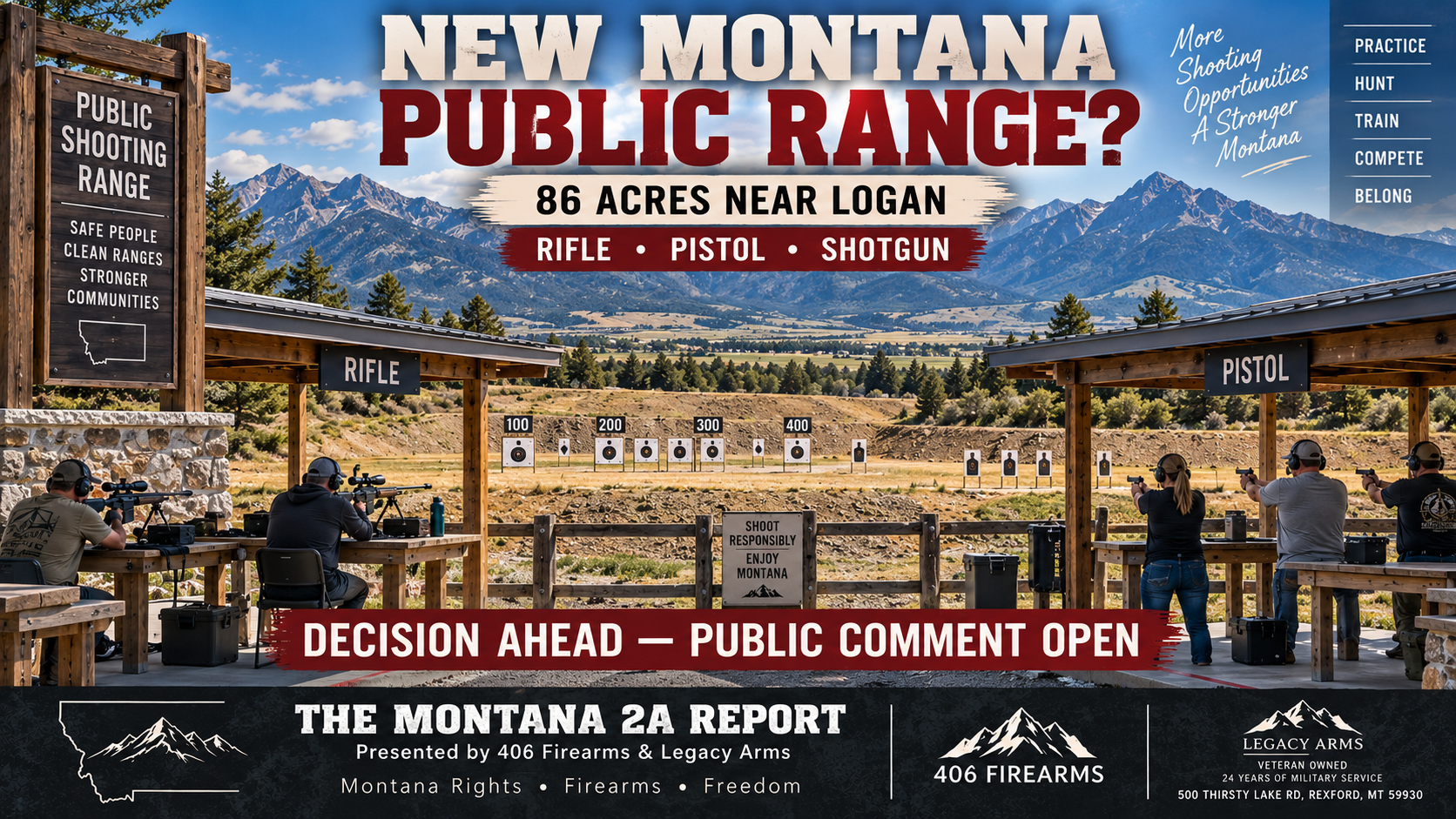
- More than 1,400 Montana shooters have spoken, and now the state has to decide what comes next. Under HB 899, Montana is evaluating the future of shooting facilities across the state—from improvements to existing community ranges to potential new facilities supporting rifle, pistol, long-range shooting, shotgun sports, archery, competition, training, and hunter education. But no massive state shooting complex has been approved, and no final location has been selected. The task force is still gathering information and developing recommendations. For rural communities like those here in Northwest Montana and the Tobacco Valley, one question deserves particular attention: should Montana concentrate its resources on one premier destination facility, or invest in accessible regional ranges closer to the people who actually use them? Today's Montana 2A Report examines what HB 899 actually authorized, what Montana shooters are asking for, what the state is considering, and why the decisions ahead could shape shooting access in Montana for years. The Montana 2A Report Presented by 406 Firearms & Legacy Arms Montana Rights • Firearms • Freedom
The Montana 2A Report
Presented by 406 Firearms & Legacy Arms
Montana Rights • Firearms • Freedom
More than 1,400 Montana shooters have now told the state what they want and need from Montana’s shooting facilities.
Now comes the harder part.
What should Montana actually do with that information?
Should the state help create a major destination shooting complex capable of hosting large competitions?
Should the priority instead be improving existing local ranges?
Should Montana focus on developing several regional facilities so rural shooters don’t have to drive hours simply to reach a quality rifle, pistol, shotgun or archery range?
Or should the answer be some combination of all three?
Those questions are no longer hypothetical.
Montana’s State Shooting Facilities and Improvements Development and Oversight Task Force, created by the Legislature through House Bill 899, is actively working toward recommendations that could shape shooting infrastructure across the state for years to come.
And for those of us in rural Northwest Montana, this deserves attention.
First, What Exactly Is HB 899?
House Bill 899 was passed by the 2025 Montana Legislature and became Chapter 750 of the 2025 Session Laws.
It created the Montana State Shooting Facilities and Improvements Development and Oversight Task Force and a dedicated state shooting-facilities-and-improvements account.
The law became effective July 1, 2025.
The Legislature gave the task force several specific assignments.
It must develop a framework for selecting locations for state shooting facilities and improvements, review shooting facilities and develop preliminary specifications and features, create a request-for-proposals process, and ultimately recommend how future facilities should be developed, located and administered.
Importantly, HB 899 expressly anticipates proposals from local governments, private-sector entities, or combinations of the two.
The law also created an account that can receive lawful public or private funding, including gifts, grants and donations, and allows that money to be used for location-selection work, improvements to existing facilities and development of funding mechanisms.
The Legislature appropriated $55,000 to FWP for the task force’s work during the biennium beginning July 1, 2025.
That’s important because HB 899 should not be confused with an appropriation to immediately construct some enormous new shooting complex.
It isn’t.
It establishes the planning structure.
More Than 1,400 Montana Shooters Responded
This is where the story becomes especially interesting.
As the task force gathered information, Montana shooters were asked about the types of facilities they use, what they need, how far they travel and what kinds of shooting opportunities are lacking.
By August, task-force co-chair Rep. Kerri Seekins-Crowe said the task force had heard from more than 1,400 shooters in Montana concerning shooting-facility needs.
She also said the group had studied shooting-facility approaches in South Dakota, Wyoming and Colorado as it develops Montana’s recommendations.
That is a meaningful amount of public participation.
And the task force isn’t merely collecting a yes-or-no answer about whether people like shooting ranges.
FWP’s task-force page currently publishes the individual and club survey charts, open-response summaries and complete responses to several survey questions, making the public input available for examination.
Montana FWP Shooting Facilities Task Force
This Is Not Just About Building One Giant Range
One misconception worth clearing up is that HB 899 simply ordered Montana to build one enormous state shooting center.
The final enacted language is broader than that.
The statute repeatedly refers to “shooting facilities and improvements.”
It specifically authorizes the task force to consider improving existing facilities as well as developing state-supported shooting facilities.
That distinction matters.
A flagship destination facility could provide something Montana currently lacks: a location capable of supporting large competitions, training events and shooting-sports tourism.
But Montana is a big state.
What works for someone living near Billings, Bozeman or Helena may not solve the problem for someone living in Lincoln County.
And that’s where I believe this conversation becomes particularly important for rural Montana.
Northwest Montana Has a Different Access Problem
Here in the Tobacco Valley, distance matters.
If you live around Rexford, Eureka or elsewhere in Lincoln County, a spectacular shooting complex several hundred miles away may be impressive—but it doesn’t necessarily solve your everyday access problem.
A hunter who wants to verify a rifle before season doesn’t necessarily need a massive competition complex.
A family teaching a new shooter doesn’t necessarily need one.
A concealed-carry student doesn’t necessarily need one.
Neither does the gun owner who simply needs a safe, properly designed place to practice.
For rural communities, accessible regional facilities may provide more practical value than one distant showcase facility.
That doesn’t mean Montana has to choose one or the other.
It means the task force should carefully distinguish between two legitimate goals:
Creating a premier statewide shooting destination and improving practical shooting access for ordinary Montanans.
Those aren’t necessarily the same mission.
What Could a Modern Montana Range Include?
Nothing in HB 899 means the following features have been approved.
They haven’t.
But as Montana develops its recommendations, there are several capabilities worth considering.
A serious modern facility could support safe pistol and rifle bays, meaningful long-range rifle capability, trap and skeet, sporting clays, archery, hunter sight-in opportunities, youth shooting programs, hunter education, competitive shooting, classrooms and instructor space.
Facilities also need to consider issues that aren’t as exciting to talk about but matter enormously when you’re trying to operate a range for decades: accessibility, parking, lead management, noise mitigation, fire prevention, emergency access, restrooms, maintenance and relationships with surrounding landowners.
For Northwest Montana in particular, wildfire risk deserves to be part of the design from day one.
Good range development isn’t simply putting berms behind targets.
It is infrastructure.
Long-Range Shooting Deserves Special Attention
One area Montana should examine carefully is legitimate long-range capability.
FWP task-force materials from the early stages of the process specifically identified the need for information about the number and location of ranges capable of approximately 800- to 1,000-yard shooting.
That makes sense.
Montana has the geography and shooting culture for long-range rifle shooting, yet properly designed facilities capable of supporting it are much harder to develop than a basic 100-yard range.
Land requirements grow.
Safety zones become more demanding.
Terrain matters.
Noise considerations increase.
And the cost climbs quickly.
If Montana wants to support precision-rifle competition, advanced marksmanship and meaningful long-range training, that capability needs to be deliberately designed rather than treated as an afterthought.
Montana Already Supports Local Shooting Ranges
HB 899 isn’t starting from zero.
Montana Fish, Wildlife & Parks has administered a Shooting Range Grant Program since 1989 using money generated from state hunting-license sales.
That program provides partial funding to shooting clubs, private organizations, local governments and school districts to establish or improve shooting ranges.
Montana FWP Shooting Range Grant Program
FWP reported that in Fiscal Year 2026, $400,000 was awarded across 15 projects, with an average award of roughly $27,000.
That existing model matters.
Montana already has experience partnering with communities and organizations rather than assuming every shooting facility must be completely state-built and state-operated.
HB 899 could build upon that experience.
There Is Also a Public-Lands Component
The task force has separately examined land issues.
Its July 16 Lands Subcommittee meeting included material specifically addressing options for authorizing shooting ranges on Montana state trust lands.
That does not mean Montana has selected a state-trust-land parcel for a new shooting complex.
It hasn’t.
It means the task force is examining the legal and practical mechanisms that could potentially make such land available.
That’s precisely the distinction we need to maintain throughout this process:
Options are not decisions.
Recommendations are not construction contracts.
And a task force is not a bulldozer.
Three Work Streams Are Taking Shape
The task force’s recent work also gives us a good indication of where the planning effort is heading.
FWP currently lists recent meetings for a Lands Subcommittee, a Shooting Complex Subcommittee, and a Funding Subcommittee.
That’s a logical breakdown.
Before Montana can seriously discuss a future facility, it has to answer three fundamental questions:
Where could it go?
What should it actually be?
And how would Montana pay for it?
Until those questions are answered, claims that Montana has already selected or approved some massive shooting complex are premature.
The State Is Looking Beyond Montana for Ideas
Montana isn’t developing this concept in isolation.
Seekins-Crowe said the task force studied shooting facilities in South Dakota, Wyoming and Colorado.
That’s smart.
Other Western states have already wrestled with questions involving land, public access, competitions, tourism, range safety and funding.
Montana doesn’t need to copy another state.
But we shouldn’t reinvent every wheel either.
The better approach is to identify what has worked elsewhere, what hasn’t, and then build a model suited to Montana’s geography and shooting culture.
The Second Amendment Is More Than Owning the Firearm
There’s a larger Second Amendment issue here as well.
The right to keep and bear arms is the constitutional foundation.
But practically exercising that right also requires opportunities to develop competence.
A firearm sitting untouched in a safe doesn’t create proficiency.
Marksmanship requires practice.
Safe gun handling requires repetition.
Hunters need places to verify zero.
New shooters need controlled environments where they can learn.
Young people need safe opportunities to enter the shooting sports.
Competitive shooters need facilities where they can train and hold events.
And responsible firearm owners need places where shooting can occur without creating unsafe informal shooting areas on public or private land.
Access to quality shooting facilities supports the responsible exercise of the right.
That should matter to Montana.
What Should Montana Prioritize?
My preference would be for Montana to resist an either-or approach.
A premier shooting complex capable of hosting major events could have real value.
It could bring competitors and visitors into Montana, create economic activity, support firearm and outdoor-industry businesses and provide training opportunities that don’t currently exist at that scale.
But the state should not accomplish that by ignoring rural access.
Montana should also strengthen and expand the network of regional and community shooting facilities that ordinary residents can actually use on a regular basis.
In a state this large, proximity is part of accessibility.
For Northwest Montana, that matters tremendously.
Here’s Where Things Stand Today
As of August 31, 2026, Montana has not announced a final location for a new state shooting complex.
There is no final statewide facility plan.
The task force is still doing the work HB 899 assigned to it.
FWP currently lists the next task-force meeting for September 18, in person with the location still listed as TBD, followed by an October 19 Zoom meeting.
Most importantly, HB 899 requires the task force to report its recommendations by June 30, 2027.
So there is still time for Montana shooters to pay attention.
And they should.
The Bottom Line
More than 1,400 Montana shooters have already spoken.
Now Montana has to decide what to do with what they said.
HB 899 gives the state an opportunity to think bigger about shooting infrastructure—but bigger shouldn’t automatically mean centralized.
A truly successful plan should consider competitive shooting, long-range capability, hunter education, youth programs, archery and shotgun sports while also addressing something much simpler:
Can ordinary Montanans get to a safe, useful shooting facility without spending half the day driving there?
For those of us in Northwest Montana, that’s the question I hope doesn’t get lost.
Montana has an opportunity to create something worthwhile here.
Not simply a monument to shooting sports.
A working statewide shooting infrastructure that serves hunters, families, competitors, instructors, new shooters and experienced firearm owners alike.
The task force has until June 30, 2027, to make its recommendations.
We’ll be watching.
And when Montana begins turning recommendations into actual proposals, locations and funding decisions, The Montana 2A Report will follow those decisions closely.
The Montana 2A Report
Presented by 406 Firearms & Legacy Arms
Montana Rights • Firearms • Freedom
24 Years Serving Our Nation. Still Serving. Still Defending Freedom.
Current Sources
The primary source is Montana Fish, Wildlife & Parks’ Shooting Facilities Task Force page, which contains the task-force mandate, membership, meeting calendar and survey materials. The enacted statutory authority is Montana Legislature — Enrolled HB 899. FWP’s longstanding range-funding program is documented at Montana Shooting Range Grants. The August public announcement reporting participation by more than 1,400 Montana shooters is also available in the state’s August 10 meeting notice.
Legal / Editorial Disclaimer
This report provides general news, public-policy analysis and commentary. It is not legal advice. Statements concerning potential facilities, locations or features are clearly identified as recommendations or possibilities; Montana has not yet approved a final shooting-facility location or statewide construction plan under HB 899.
#Montana 2A, #Montana Shooting Ranges, #HB 899, #Montana Shooting Sports, #Montana Gun Owners, #Montana FWP, #Shooting Range Development, #Long Range Shooting, #Montana Hunters, #Northwest Montana, #Lincoln County, #Tobacco Valley, #Firearms Training, #Second Amendment, #406 Firearms, #Legacy Arms