

Montana Takes the Magazine-Ban Fight to the U.S. Supreme Court — And the Justices Still Haven’t Said No
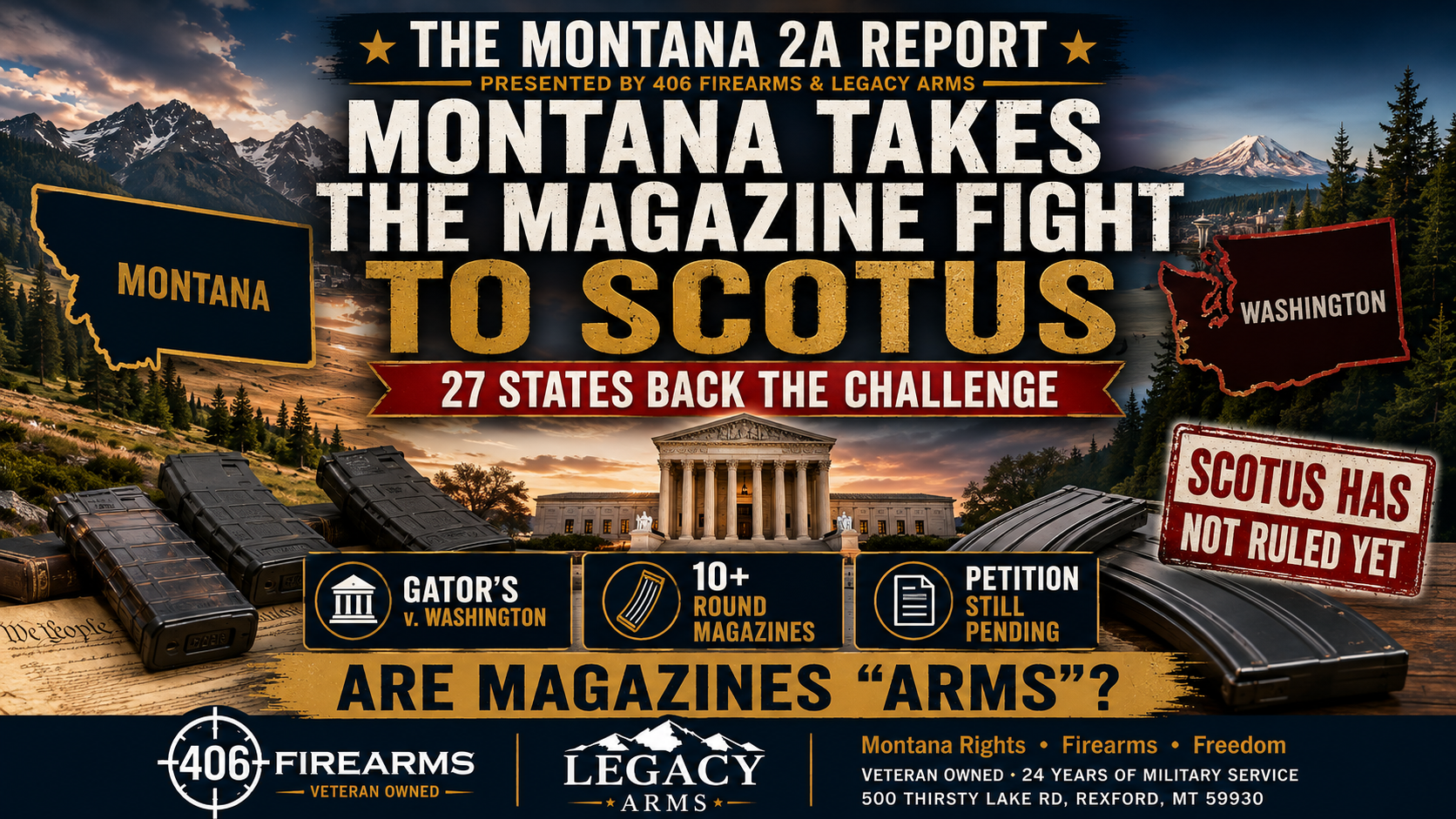
- A major Second Amendment case remains alive at the Supreme Court of the United States—and Montana is directly involved. In Gator’s Custom Guns, Inc. v. Washington, the justices are being asked whether ammunition-feeding devices capable of holding more than 10 rounds are “Arms” presumptively protected by the Second Amendment. The Washington Supreme Court upheld that state’s magazine restriction in May 2025. Gator’s then petitioned the U.S. Supreme Court, where Montana, Idaho and 25 other states filed an amicus brief supporting the challenge. Here is the critical status as of September 2, 2026: the Supreme Court has NOT granted certiorari. But it hasn't denied the petition either. The case went through an extraordinary series of conference distributions through June, and Gator’s filed another supplemental brief on August 3. Today's Montana 2A Report examines what the case actually asks, why Montana joined it, why its outcome could reach far beyond Washington, and what Montana gun owners should—and should not—conclude while the Supreme Court considers its next move. The Montana 2A Report Presented by 406 Firearms & Legacy Arms Montana Rights • Firearms • Freedom.
The Montana 2A Report
Presented by 406 Firearms & Legacy Arms
Montana Rights • Firearms • Freedom
There is a Second Amendment case sitting before the United States Supreme Court that Montana gun owners should be watching closely.
And Montana isn’t watching from the sidelines.
In Gator’s Custom Guns, Inc. v. Washington, No. 25-153, Montana joined Idaho and 25 other states in asking the Supreme Court to review Washington’s restriction on magazines capable of holding more than 10 rounds.
The question presented to the justices is straightforward but potentially enormous:
Are ammunition-feeding devices capable of holding more than ten rounds “Arms” presumptively entitled to constitutional protection under the plain text of the Second Amendment?
As of September 2, 2026, however, one fact needs to be stated before anything else:
The Supreme Court has NOT agreed to hear the case.
There has been no grant of certiorari.
There has also been no denial.
And after an unusually long journey through the Court’s conference process, that makes this case worth another look.
How We Got Here
Washington enacted ESSB 5078 in 2022.
The law prohibits the manufacture, importation, distribution, sale or offering for sale of magazines capable of accepting more than 10 rounds, subject to specified exceptions.
Gator’s Custom Guns and owner Walter Wentz challenged the restriction.
A Cowlitz County Superior Court judge initially sided with Gator’s and found the restriction unconstitutional.
Washington appealed.
Then, on May 8, 2025, the Washington Supreme Court reversed.
The state high court held that magazines holding more than 10 rounds were not “Arms” within the meaning of the federal or Washington constitutions and concluded that purchasing them was not an ancillary right necessary to exercise the core right to possess a firearm for self-defense.
Two justices dissented.
The dissent took almost exactly the opposite view, reasoning that magazines are integral components of repeating firearms and that regulations on them implicate constitutionally protected arms-bearing conduct.
That disagreement eventually landed at the doorstep of the United States Supreme Court.
Gator’s Asked SCOTUS to Step In
Gator’s filed its petition for a writ of certiorari on August 6, 2025.
The case was docketed as No. 25-153.
Official U.S. Supreme Court Docket — Gator’s Custom Guns v. Washington
The petition asks the Court to decide:
Whether ammunition feeding devices with the capacity to hold more than ten rounds are “Arms” presumptively entitled to constitutional protection under the plain text of the Second Amendment.
That question matters well beyond Washington.
If the Supreme Court eventually accepts the case and issues a merits decision defining magazines as protected “Arms,” the resulting constitutional rule could affect magazine restrictions throughout the country.
But we’re not there yet.
A petition asks the Supreme Court to hear a case.
It is not a Supreme Court ruling.
Montana Didn’t Just Support the Case—It Helped Lead the States’ Brief
On September 8, 2025, Montana, Idaho and 25 other states filed an amicus curiae brief supporting Gator’s petition.
The brief identifies the participating jurisdictions as Montana, Idaho, Alabama, Alaska, Arkansas, Florida, Georgia, Iowa, Indiana, Kansas, Kentucky, Louisiana, Mississippi, Missouri, Nebraska, New Hampshire, North Dakota, Ohio, Oklahoma, South Carolina, South Dakota, Tennessee, Texas, Utah, West Virginia and Wyoming, along with the Arizona Legislature.
That’s 27 states, plus the Arizona Legislature.
And Montana’s role was prominent.
The filing lists Montana Attorney General Austin Knudsen and Montana Solicitor General Christian Corrigan alongside Idaho Attorney General Raúl Labrador and Idaho Solicitor General Alan Hurst. The official Supreme Court docket also lists Corrigan as counsel for “Montana, et al.”
The states urged the Supreme Court to grant certiorari and reverse the Washington Supreme Court.
Their argument is that magazines holding more than 10 rounds are widely possessed for lawful purposes and therefore fall within Second Amendment protection.
That’s the states’ legal argument.
It is not yet the holding of the United States Supreme Court.
That distinction is important.
The Numbers Are Part of Montana’s Argument
The states’ brief highlighted just how common these magazines are.
Citing figures acknowledged in the Washington litigation, the brief notes estimates ranging from 30 million to 159.8 million magazines capable of holding more than 10 rounds in circulation and states that approximately 48 percent of gun owners have owned such magazines.
The states use those numbers to support a fundamental part of their constitutional argument:
Something possessed by millions of Americans for lawful purposes should not simply be removed from Second Amendment analysis by labeling it an accessory rather than an “Arm.”
Washington disagrees.
And that is precisely the constitutional dispute the petition asks the Supreme Court to resolve.
Then Something Unusual Happened
The Supreme Court started considering the petition.
And kept considering it.
The official docket shows Gator’s was distributed for the Court’s December 5, 2025 conference.
Then December 12.
January 9.
January 16.
January 23.
February 20.
February 27.
March 6.
March 20.
March 27.
April 2.
April 17.
April 24.
May 1.
May 14.
May 21.
May 28.
June 4.
June 11.
June 18.
June 25.
And finally the June 29 conference.
That’s an extraordinary amount of conference activity.
But we need to be disciplined about what it means.
A repeated relist does not mean the petition will be granted.
It does not tell us how any justice will ultimately vote.
And it certainly does not mean Washington’s magazine restriction has been struck down.
What it does tell us is that the petition was not quickly disposed of.
And Then Came August 3
The docket contains another important development.
On August 3, 2026, Gator’s filed another supplemental brief with the Supreme Court.
That is currently the most recent substantive entry shown on the official docket.
So, as we publish this report on September 2:
Petition pending.
No certiorari grant.
No certiorari denial.
No Supreme Court merits decision.
Those four lines are the most important status update in this entire article.
Why Montana Gun Owners Should Care About a Washington Law
Someone might reasonably ask:
“Washington isn’t Montana. Why should we care?”
Because Supreme Court Second Amendment cases don’t necessarily remain confined to the state where they began.
Montana currently takes a substantially different legislative approach to firearms than Washington.
But a Supreme Court decision interpreting the meaning of “Arms” under the Second Amendment would establish federal constitutional precedent.
That could affect future challenges involving magazine restrictions elsewhere and potentially influence how lower courts evaluate regulations involving other firearm components.
And there is another reason Montana should care.
We live next door.
Northwest Montana residents regularly travel throughout the Inland Northwest.
The laws can change dramatically when you cross state lines.
A firearm configuration, magazine or other item that is lawful in Montana is not automatically lawful everywhere a Montanan travels.
Montana law does not follow you across the Idaho border into Washington.
That practical reality alone makes cases coming out of our neighboring states worth watching.
This Is Bigger Than One Gun Store
Gator’s Custom Guns is the named petitioner.
But the constitutional question is far broader than one retailer.
At issue is whether a government can characterize a magazine as something outside the Second Amendment’s protection before the government must justify its regulation under the constitutional framework established by Supreme Court precedent.
The Washington Supreme Court said magazines holding more than ten rounds aren’t protected “Arms.”
The dissent disagreed.
Montana and its coalition disagree.
Gator’s disagrees.
Washington continues to defend the law.
Now the petition asks nine justices in Washington, D.C., whether they will enter that dispute.
The Bigger National Magazine Fight
Gator’s also isn’t occurring in isolation.
Magazine restrictions have generated constitutional litigation in several jurisdictions, including California, Rhode Island, New Jersey and elsewhere.
That matters because disagreements among courts about how to interpret the Supreme Court’s decisions in Heller, Bruen and Rahimi create pressure for clearer nationwide guidance.
The Montana-led states’ brief expressly argued that courts have been misapplying Supreme Court Second Amendment precedent in cases involving commonly owned firearms and magazines.
Whether the Supreme Court agrees with that characterization is another question.
But there is plainly a continuing national legal fight over how the Second Amendment applies to commonly possessed magazines.
What This Case Does NOT Mean Today
This is where Second Amendment reporting needs to remain accurate.
As of September 2, 2026:
SCOTUS has not struck down magazine bans nationwide.
SCOTUS has not declared magazines holding more than ten rounds constitutionally protected.
SCOTUS has not granted Gator’s petition.
Washington’s restriction has not disappeared because this petition exists.
And nothing about this pending case changes Montana law today.
The current proceeding is a petition for certiorari.
That means Gator’s is asking the Supreme Court to accept the case for review.
Until the Court actually issues an order, anyone claiming that the Supreme Court has already “taken the case” or “ruled against magazine bans” is getting ahead of the docket.
What Happens Next?
The next meaningful event will be another Supreme Court docket entry.
The justices could eventually grant review.
They could deny review.
They could take some other procedural action.
The long relist history and subsequent supplemental briefing make the case interesting, but none of that guarantees an outcome.
For now, the correct description is simple:
Gator’s Custom Guns v. Washington remains pending before the United States Supreme Court.
And Montana is on the record asking the Court to hear it.
The Montana Perspective
Montana’s participation in this case is worth paying attention to because it represents something larger than opposition to one Washington statute.
Montana is arguing for a constitutional principle.
If a firearm component is commonly possessed by law-abiding Americans and integral to the operation of modern firearms, the state argues that courts shouldn’t simply exclude it from Second Amendment protection before performing the constitutional analysis required by Supreme Court precedent.
Whether the Supreme Court accepts that argument remains unresolved.
But Montana has put its name on the brief.
And for Montana firearm owners, manufacturers, retailers, gunsmiths and shooters, that’s worth knowing.
The Bottom Line
The Supreme Court has had Gator’s Custom Guns v. Washington in front of it for months.
Montana, Idaho and 25 other states have asked the Court to intervene.
The case asks a foundational question:
Are magazines capable of holding more than ten rounds protected “Arms” under the Second Amendment?
The Washington Supreme Court said no.
Gator’s says yes.
Montana says yes.
Twenty-six other states joined that position.
And the United States Supreme Court still hasn’t given us its answer.
That makes this one worth watching.
When the docket moves, The Montana 2A Report will follow it.
The Montana 2A Report
Presented by 406 Firearms & Legacy Arms
Montana Rights • Firearms • Freedom
Veteran Owned • 24 Years of Military Service • Still Serving. Still Defending Freedom.
Current Sources
The authoritative case status is available directly from the U.S. Supreme Court’s official docket for Case No. 25-153. Montana, Idaho and the other states’ arguments can be read in the official multistate amicus brief filed with the Supreme Court. The Washington Supreme Court’s May 2025 ruling provides the underlying state-court decision.
Legal Disclaimer
This article provides news, public-policy analysis and general information concerning pending litigation. It is not legal advice. Firearm and magazine laws vary by jurisdiction and can change through legislation, regulation and court decisions. Verify current law before transporting firearms or magazines across state lines.
#Montana2A #TheMontana2AReport #406Firearms #LegacyArms #SecondAmendment #MontanaGunOwners #SCOTUS #GunRights #MagazineBan