

Montana Sets 300-Wolf Harvest Quota — Northwest Montana Takes the Lead
- Today's catch-up edition covers the August 19 Montana Fish and Wildlife Commission decision establishing the 2026–27 wolf hunting and trapping regulations. I rechecked the story this morning against current Montana Fish, Wildlife & Parks material and subsequent reporting. The Commission adopted a 300-wolf recreational harvest quota, above FWP's recommended 250 but substantially below last season's 452 quota. The final vote was reported as 4–2. Northwest Montana's Region 1 receives the largest share of the quota. The official FWP Commission page confirms that the 2026–27 wolf hunting and trapping regulations were taken up for final action at the August 19, 2026 meeting, while FWP's Hunt Planner was moved to the new regulation year on August 20. FWP's general wolf page still shows some 2026 season dates as TBD, so readers should verify current season details directly with FWP before hunting. Montana FWP — August 19 Commission Meeting (https://fwp.mt.gov/aboutfwp/commission/august-2026-meeting?utm_source=chatgpt.com) Montana FWP — Current Wolf Regulations (https://fwp.mt.gov/hunt/regulations/wolf?utm_source=chatgpt.com)
The Montana 2A Report
Presented by 406 Firearms & Legacy Arms
August 26, 2026
For hunters in Northwest Montana, one of the most consequential wildlife-management decisions of the year has now been made.
On August 19, the Montana Fish and Wildlife Commission approved the state’s wolf hunting and trapping regulations for the upcoming 2026–27 season.
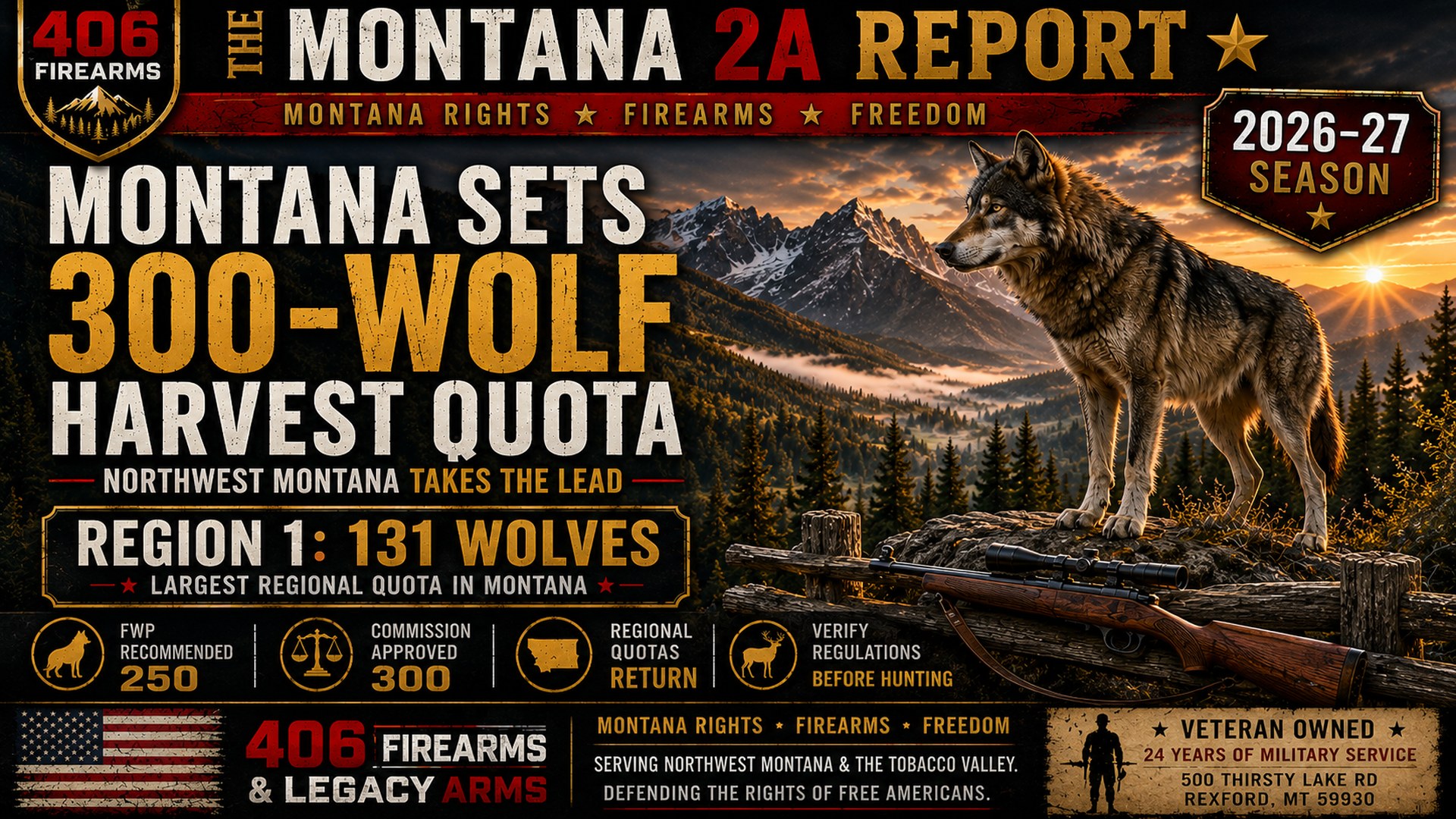
At the center of that decision is a 300-wolf recreational harvest quota.
That number represents a substantial reduction from last season’s quota of 452 wolves—but it is also 50 wolves higher than the 250-wolf quota recommended by Montana Fish, Wildlife & Parks.
And for those of us in Northwest Montana, there’s an even more important part of the story:
Region 1 will carry the largest wolf quota in the state.
The Numbers
The final regional quotas reported following the Commission’s August 19 action are:
Region 1 — 131 wolves
Region 2 — 92 wolves
Region 3 — 33 wolves
Region 4 — 28 wolves
Region 5 — 6 wolves
Region 6 — 4 wolves
Region 7 — 4 wolves
Separate quotas of one wolf each in Wolf Management Units 313 and 316 bring the recreational harvest total to 300 wolves statewide.
For Northwest Montana hunters, that Region 1 number jumps off the page.
Region 1 includes Lincoln, Flathead, Lake and Sanders counties and contains a substantial share of Montana’s wolf population. Recent reporting on the Commission decision cites an estimate of roughly 300 wolves within Region 1 alone.
For hunters around Eureka, Rexford, the Tobacco Valley and the rest of Lincoln County, this isn’t a distant wildlife-policy debate happening in Helena.
We’re sitting in the region that will account for more than one-third of Montana’s recreational wolf quota.
Why Did Montana Reduce the Quota?
The biggest factor is a major change in Montana’s wolf population estimate.
FWP’s previous population model produced a 2025 estimate of approximately 1,094 wolves.
The state’s updated modeling produced a substantially lower estimate—approximately 725 wolves.
That difference changed the management conversation considerably.
With the new population estimate in hand, FWP recommended reducing the recreational harvest quota to 250 wolves for 2026–27.
The Commission ultimately chose 300.
The Commission Didn’t Simply Accept FWP’s Recommendation
That’s an important distinction.
FWP recommended 250.
The Fish and Wildlife Commission adopted 300.
Region 1 Commissioner Ian Wargo proposed returning to regional quotas rather than relying solely on one statewide number.
Before the August 19 meeting, one version of the proposal contemplated regional quotas totaling more than 300 wolves. During the Commission process, those numbers were modified, ultimately producing the final 300-wolf total.
The final regulations reportedly passed 4–2.
Commissioners who opposed the final package did not necessarily reject regional management itself. Reporting from the meeting indicates concern that regional wildlife staff had not been given sufficient opportunity to develop or review the individual regional numbers.
That distinction matters because wildlife management debates are rarely as simple as “pro-hunting” versus “anti-hunting.”
There are legitimate disagreements over population models, regional distribution, livestock depredation, elk recruitment, harvest pressure and how aggressively Montana should manage predators.
Why Regional Quotas Matter
For Northwest Montana, moving back toward regional quotas makes practical sense for one fundamental reason:
Montana’s wolves aren’t evenly distributed across Montana.
A statewide number by itself can hide enormous regional differences.
Region 1 has wolves.
Parts of eastern Montana may see only occasional animals.
Treating those two environments as though they have identical management needs doesn’t necessarily produce the best result.
Regional quotas allow wildlife managers to account for where wolves actually live and where predator pressure is occurring.
They also create an important safeguard.
Once a regional quota is reached, harvest can be closed in that region rather than allowing hunters and trappers in one wolf-heavy portion of Montana to consume an unlimited share of the statewide quota.
That makes the Region 1 number particularly important for Northwest Montana hunters.
What Happened Last Season?
The previous recreational quota was much higher.
For the 2025–26 season, Montana established a quota of approximately 452 wolves.
Actual recreational harvest never came close to filling it.
Reporting following the August Commission meeting put the 2025–26 recreational harvest at approximately 247 wolves, including 145 taken by hunters and 102 by trappers.
Additional wolves were removed through livestock-depredation and other management actions.
That provides some useful perspective.
A quota is a maximum authorized recreational harvest, not a prediction that exactly that many wolves will be taken.
Setting a quota of 300 therefore does not mean Montana will automatically remove 300 wolves through hunting and trapping.
Actual harvest depends on hunter and trapper participation, weather, access, wolf distribution, trapping restrictions, regional closures and plain old hunting difficulty.
Anyone who has actually tried hunting wolves in Northwest Montana knows that putting a wolf tag in your pocket and putting a wolf on the ground are two very different things.
Montana Still Has a Federal Line It Cannot Cross
Wolf management is also connected to federal law.
Montana regained management authority over wolves following federal delisting in 2011.
FWP says its management program is intended to maintain a sustainable wolf population while preventing the species from again qualifying for federal protection under the Endangered Species Act.
FWP identifies 15 breeding pairs and 150 wolves as the historical minimum federal management objectives for Montana, while current state management discussions use substantially higher population levels as safeguards against federal relisting.
That creates a balancing act.
Montana has an interest in managing wolves as a state wildlife resource.
Hunters and ranchers have an interest in predator management.
At the same time, driving the population too low could invite renewed federal intervention.
And once Washington takes management authority back, Montana hunters, ranchers and wildlife managers lose control over decisions that are better made here.
Wolf Management Is Also a Firearms Issue
At first glance, wolf quotas may look more like a hunting story than a Second Amendment story.
But Montana’s hunting culture and firearms culture are deeply connected.
Federal Pittman-Robertson excise taxes on firearms, ammunition and archery equipment help finance wildlife conservation and management across Montana.
FWP’s own wolf-management plan specifically recognizes the role those revenues play in wildlife surveys, research, hunter education and other management programs.
That’s an important fact that routinely gets lost in national debates over firearms.
America’s hunters, shooters and firearm owners directly finance wildlife conservation.
Buying ammunition isn’t merely participating in shooting sports.
Buying firearms isn’t merely exercising a constitutional right.
Those purchases also generate federal conservation funding that comes back to states like Montana.
That’s one reason the relationship between firearms ownership, hunting and conservation deserves to be understood rather than caricatured.
What Northwest Montana Hunters Need to Watch
The Commission vote establishes the policy direction, but hunters should still verify the final published regulations before heading into the field.
As of this morning, FWP’s wolf webpage still displays some 2026 season dates as “TBD,” even though FWP’s Hunt Planner was updated to the 2026–27 regulation year on August 20.
That means hunters should not rely on an old regulation booklet, a Facebook post—or even this article—for the final legal season details.
Check FWP before hunting.
The agency currently reiterates several important wolf-harvest requirements, including mandatory harvest reporting and inspection requirements. FWP states that harvested wolves must be reported within 24 hours, and the hide and skull must be presented to a designated FWP employee within 10 days for tagging, tissue sampling and tooth extraction.
First-time wolf trappers also must successfully complete an approved wolf trapping certification course before setting traps.
Don’t Confuse Hunting Regulations With Wildlife-Control Authority
Another distinction matters.
The 300-wolf figure concerns the recreational hunting and trapping quota.
It should not automatically be interpreted as a cap on every wolf mortality in Montana.
Wolves may also be removed through livestock-depredation control and other authorized management actions.
That is why claims such as “Montana is killing exactly 300 wolves” are misleading.
The Commission authorized a recreational harvest framework with a maximum quota.
Actual recreational harvest may be lower.
Total wolf mortality from all causes may be higher.
Precision matters—especially when this issue is politically charged.
The Debate Isn’t Going Away
Wolf management produces some of the most polarized wildlife politics in Montana.
Wolf-advocacy organizations sharply criticized the Commission’s decision, arguing that 300 is too high given the revised population estimate.
Some hunters and predator-management advocates believe the state remains too conservative and point to livestock conflicts, elk recruitment and the concentration of wolves in western Montana.
Those are competing policy positions.
The established facts are narrower:
FWP recommended 250.
The Commission adopted 300.
The quota is substantially lower than last season’s 452.
Regional quotas have returned.
And Northwest Montana’s Region 1 receives by far the largest allocation.
What This Means Around Eureka and Rexford
For our part of Montana, this decision is especially relevant.
Lincoln County lies squarely inside Region 1.
We live, hunt and recreate in wolf country.
For local hunters, the regional quota means harvest activity in Northwest Montana will now be measured against a specific Region 1 ceiling instead of simply disappearing into a statewide number.
That should make it easier to see how much harvest pressure is actually occurring here.
It also means hunters need to pay attention to regional quota status throughout the season.
Don’t assume a statewide season being open automatically means Region 1 remains open.
Before heading out, check the current FWP regulations and quota status.
The Bottom Line
Montana has chosen a middle path for the 2026–27 wolf season.
The state didn’t retain last year’s aggressive 452-wolf quota.
It also didn’t accept FWP’s recommendation of 250.
The Commission settled on 300 wolves and restored regional quotas, with Northwest Montana carrying the largest share.
Whether 300 ultimately proves too high, too low or about right will depend on actual harvest, population monitoring and the performance of Montana’s revised population model.
But one principle shouldn’t be controversial:
Wildlife decisions affecting Montana should be based on credible science, transparent management and the realities experienced by the people who actually live on this landscape.
Montana hunters have an important role in that system.
So do ranchers.
So do wildlife biologists.
And so do the firearm owners whose purchases help fund conservation in the first place.
We’ll be watching Region 1 closely as the season develops.
Montana Rights • Firearms • Freedom.
Serving Northwest Montana & the Tobacco Valley. Defending the Rights of Free Americans.
The Montana 2A Report is presented by 406 Firearms & Legacy Arms — Veteran Owned • 24 Years of Military Service • 500 Thirsty Lake Rd, Rexford, MT 59930.
Current Sources
Montana FWP — August 19 Fish and Wildlife Commission Meeting
Montana FWP — Wolf Hunting Regulations and Current Guidance
Montana FWP — Wolf Conservation & Management Program
Montana FWP — Hunt Planner 2026–27 Update
Western News — Northwest Montana Wolf Quota Report, August 25
Legal/Regulatory Disclaimer: This article is provided for general informational purposes and is not legal advice or a substitute for current Montana hunting regulations. Wildlife seasons, quotas, closures and trapping requirements can change. Hunters and trappers should verify current regulations, regional quota status and closures directly with Montana Fish, Wildlife & Parks before hunting or trapping.
#Montana Wolf Hunting, #Montana Hunting, #Montana FWP, #Wolf Management, #Region 1, #Northwest Montana, #Lincoln County, #Wolf Hunting, #Wolf Trapping, #Montana Hunters, #Wildlife Management, #2026 Hunting Season, #Tobacco Valley, #Montana Outdoors, #406 Firearms, #Legacy Arms