

Montana AG Warns Gun Owners: Federal NFA Victory Collides With Montana Law
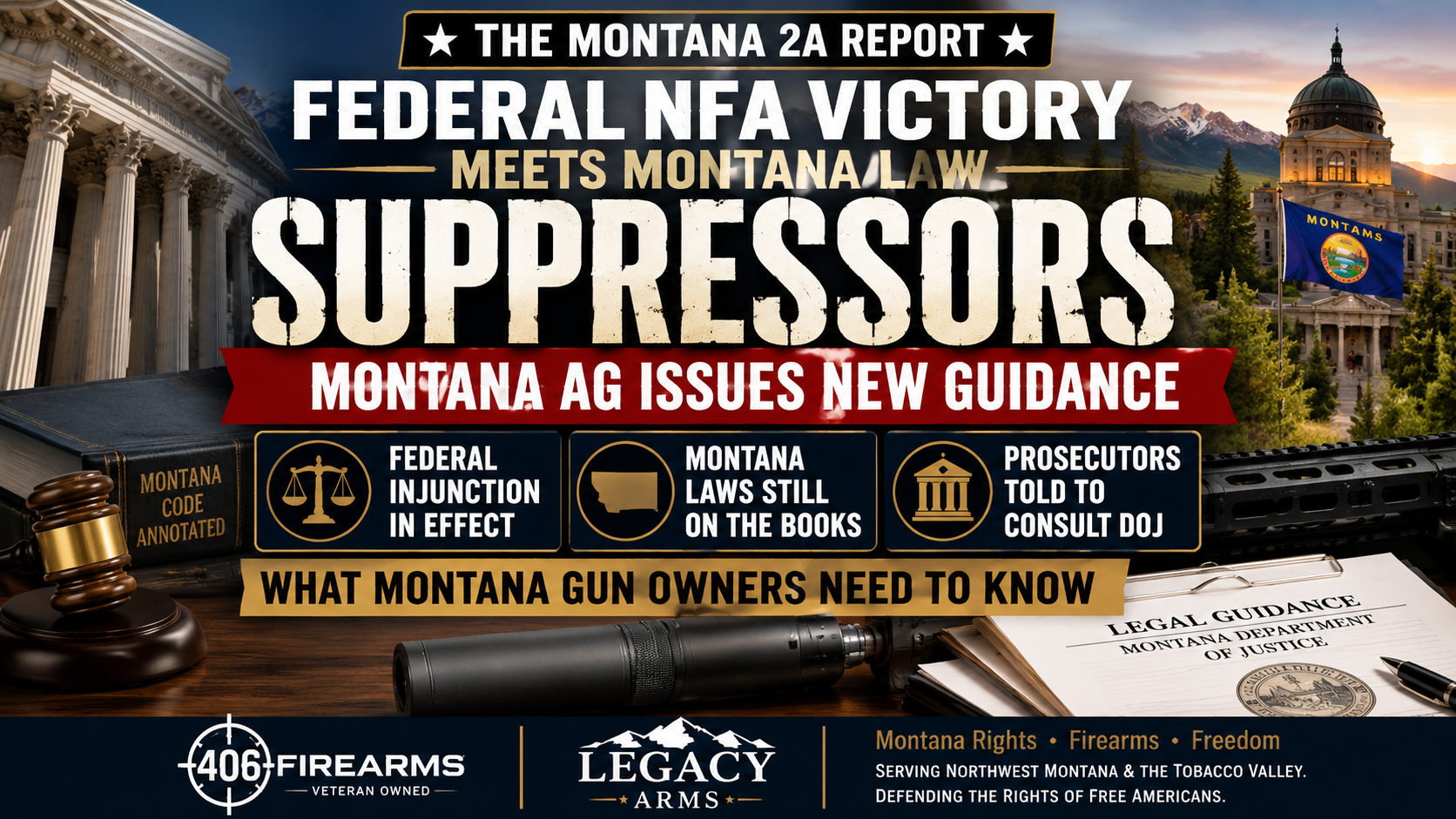
The Montana 2A Report
Presented by 406 Firearms & Legacy Arms
Montana Rights • Firearms • Freedom
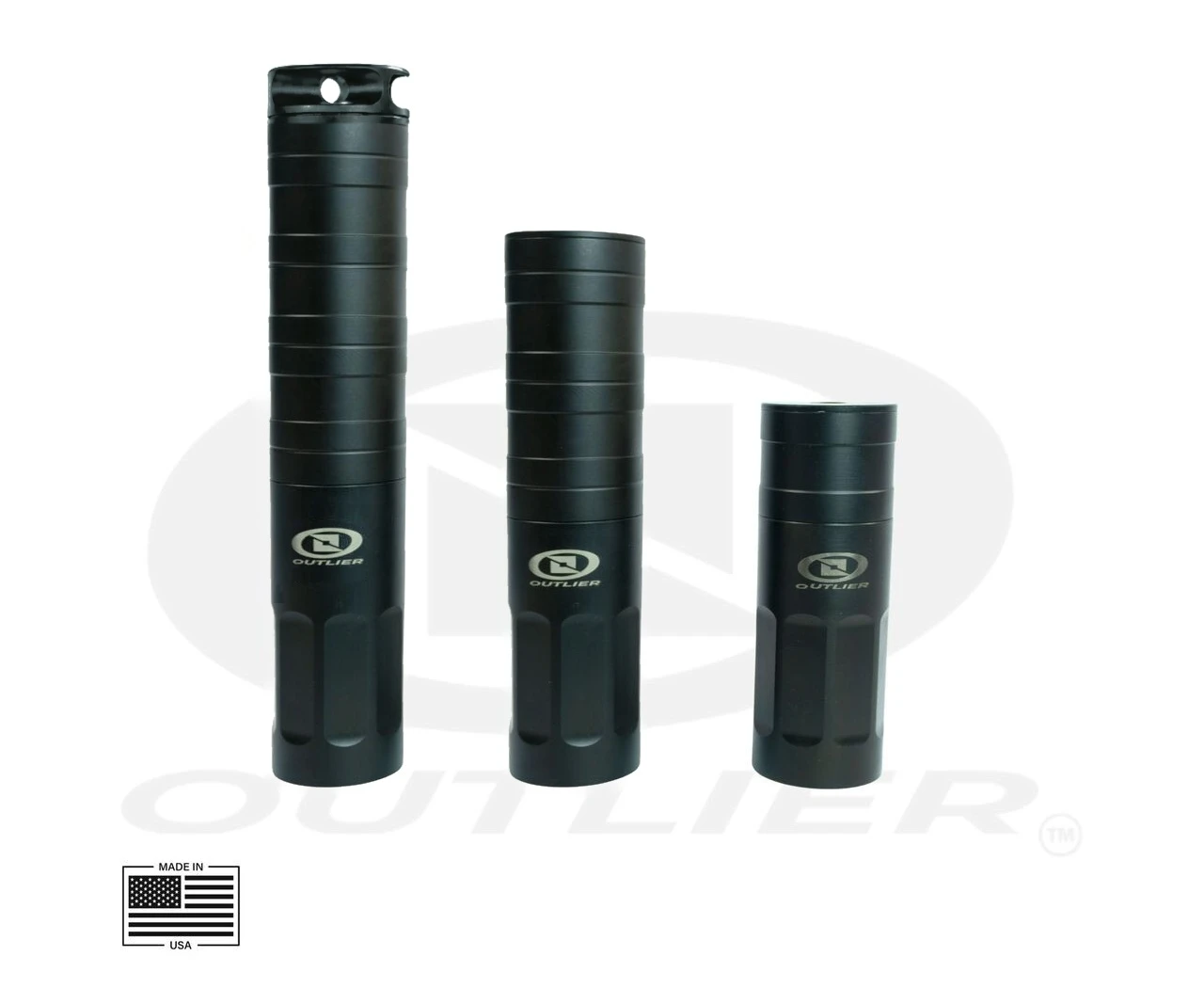
A major federal victory over the National Firearms Act has created an unexpected problem for gun owners right here in Montana.
The federal government may now be prohibited from enforcing major NFA registration requirements against certain protected people and organizations.
But Montana law still contains provisions built around the federal registration system that the court just enjoined for those protected parties.
Montana Attorney General Austin Knudsen addressed that conflict directly on August 27, issuing a five-page guidance letter to Montana prosecutors, county sheriffs and chiefs of police concerning Silencer Shop Foundation v. ATF.
The guidance covers suppressors, short-barreled rifles, short-barreled shotguns and their intersection with existing Montana law.
And perhaps the most significant part of the Attorney General’s guidance is this:
Knudsen isn’t simply telling Montana law enforcement what the statutes say.
He’s warning them that prosecuting otherwise law-abiding Montanans under those statutes may now be legally tenuous and asking prosecutors to send such cases to the Montana Department of Justice for review before charges are filed.
That makes this much more than another national NFA story.
This is now a Montana problem.
How Did We Get Here?
The story begins with Congress.
Legislation signed into law on July 4, 2025 reduced the NFA making and transfer taxes to zero for suppressors, short-barreled rifles, short-barreled shotguns and certain other NFA firearms.
Those tax changes took effect in 2026.
That created a fundamental constitutional question.
The National Firearms Act had historically been defended as an exercise of Congress’s constitutional taxing power. Registration, approval and recordkeeping requirements supported collection and enforcement of that tax.
But what happens when the tax becomes zero?
Plaintiffs including firearm organizations, businesses, individuals and several states — including Montana — went to court to find out.
On August 5, 2026, U.S. District Judge James Wesley Hendrix of the Northern District of Texas ruled in Silencer Shop Foundation v. ATF, consolidated with Jensen v. ATF, that the challenged NFA regulatory provisions could no longer be supported by Congress’s taxing power as applied to the firearms whose making and transfer taxes had been eliminated.
The court permanently enjoined enforcement of the challenged provisions against the plaintiffs and, where applicable, their agencies, political subdivisions, members and customers.
This Was NOT a Second Amendment Ruling
This distinction is important.
Judge Hendrix did not decide the plaintiffs’ Second Amendment claims.
The court instead resolved the case on Article I enumerated-powers grounds.
The judge concluded that once Congress eliminated the revenue-producing taxes, the challenged regulatory provisions could no longer be justified under the taxing power that had historically supported them.
Because that conclusion provided the plaintiffs the necessary relief, the court declined to reach the Second Amendment question.
That’s legally important — and it’s exactly the kind of distinction that gets lost when this case is reduced to a social-media headline.
The NFA Is NOT Gone Nationwide
This needs to be said plainly:
The National Firearms Act has not simply disappeared.
Judge Hendrix specifically rejected universal relief.
The injunction protects the plaintiffs and, where applicable, their agencies, political subdivisions, members and customers — both current and future.
Montana itself was a plaintiff, but the Attorney General’s guidance makes clear that Montana’s participation does not automatically extend the injunction to every Montana resident.
For the State of Montana, the injunction applies to the state and its agents or employees and political subdivisions — not every citizen simply because they live here.
The court’s seven-day stay expired after ATF declined to seek an immediate stay.
As of the Attorney General’s August 27 guidance, the injunction was therefore in effect for eligible protected parties. Knudsen also emphasized that ATF still had time to appeal and that the litigation remained subject to rapid change.
As of our August 29 review, I found no authoritative source showing that a higher court has stayed or overturned Judge Hendrix’s injunction.
That means the injunction remains the operative ruling for the protected parties — but the legal situation is not finished.
Now Comes the Montana Problem
Here is where things get interesting.
Montana has historically allowed lawful suppressor ownership.
But portions of Montana’s statutes were written with the assumption that lawful suppressors and certain short-barreled firearms would continue traveling through the federal NFA registration system.
The federal court has now disrupted that assumption.
The federal rules moved.
Montana’s statutes didn’t.
Montana’s Suppressor Law Deserves Careful Explanation
This is probably the most important correction to some of the shorthand descriptions circulating about Montana law.
Montana Code Annotated §45-8-336 provides that a person commits the offense of possession of a silencer when the person possesses, manufactures, transports, buys or sells a silencer and has the purpose of using it to commit an offense, or knows another person has such a purpose.
So the underlying offense contains an unlawful-purpose requirement.
But then Montana Code §45-8-337 creates the problem.
It provides that possession of a silencer not registered under federal law is prima facie evidence of a purpose to use that silencer to commit an offense.
In other words, Montana law uses the absence of federal registration as evidence supporting an element of the silencer offense.
And the penalties associated with §45-8-336 are severe.
A conviction carries five to 30 years in state prison, a fine of $1,000 to $20,000, or both.
That creates a bizarre situation.
A Montana resident protected by Judge Hendrix’s injunction may potentially possess or acquire a suppressor without the traditional federal NFA registration process.
Yet Montana law still treats the absence of that federal registration as prima facie evidence relevant to a state criminal offense.
That is the collision Knudsen is warning about.
Montana’s Attorney General Doesn’t Want Law-Abiding Citizens Caught in the Middle
This is where the August 27 guidance becomes particularly significant.
The Montana DOJ expressly states that it does not want otherwise law-abiding Montana citizens criminally prosecuted at the state or municipal level for conduct that is, at least for the time being, federally lawful under Judge Hendrix’s order.
Knudsen then tells Montana law enforcement that criminal investigations involving the relevant suppressor and sawed-off-firearm statutes “may be tenuous given the current legal environment.”
He goes a step further.
City and county attorneys presented with cases involving §§45-8-336, 45-8-337, 45-8-340 or 87-6-401(1)(c) are being asked to submit those cases to the Montana DOJ’s Prosecution Services Bureau for review and advisement before charges are formally filed.
That is a significant message from Montana’s chief legal officer.
But it is equally important to understand what it doesn’t do.
The Attorney General’s guidance does not repeal those statutes.
Only the Legislature can change Montana statutory law.
Short-Barreled Rifles and Shotguns Create Another Problem
Montana doesn’t use exactly the same terminology as the federal NFA.
Montana Code §45-8-340 instead regulates certain “sawed-off firearms.”
The statute applies to rifles or shotguns originally manufactured at lawful dimensions and subsequently modified below the dimensions specified by Montana law.
One of the statutory exceptions is possession by someone with a valid federal tax stamp issued by ATF.
And there is the problem again.
Montana wrote an exception around a federal document that the Hendrix injunction may mean a protected person is no longer required to obtain for covered activity.
Knudsen’s guidance therefore warns that a Montana resident protected from federal NFA enforcement could nevertheless face exposure under Montana’s existing sawed-off-firearm statute.
The penalties here are different from the suppressor statute.
A first conviction under §45-8-340 can result in a $200–$500 fine, five days to six months in county jail, or both.
Subsequent offenses can carry substantially greater penalties, including potential felony exposure.
Again:
Federal protection does not automatically rewrite Montana law.
Montana Hunters Need to Pay Particular Attention
For Montana hunters, there is yet another statutory problem.
Montana Code §87-6-401(1)(c) generally prohibits using a device designed to silence, muffle or minimize the report of a firearm while hunting.
But Montana provides an exception for a device registered with ATF.
The Attorney General’s guidance interprets that provision as continuing to require NFA registration for suppressor use while hunting.
That means someone potentially protected from federal registration requirements should not assume the federal injunction automatically authorizes hunting in Montana with a non-federally-registered suppressor.
This is especially important as Montana moves toward fall hunting seasons.
For hunters, this isn’t an academic legal debate.
It’s a practical compliance issue.
What About Montana FFLs, SOTs and Gunsmiths?
This situation becomes even more complicated for businesses.
A Montana FFL should not interpret the federal decision as permission to abandon normal procedures across the board.
The injunction is party-specific.
Customer status matters.
The particular commercial plaintiff or organizational relationship may matter.
The firearm category matters.
Independent Gun Control Act requirements may still matter.
State law matters.
And the federal government’s interpretation and implementation of the injunction remain developing issues.
Even Silencer Shop’s current guidance distinguishes between different NFA categories and transactions rather than treating the decision as a blanket end to Form 4 processing.
For Montana dealers, manufacturers and gunsmiths, the prudent response is therefore:
Verify first. Act second.
A Facebook meme saying “the NFA is dead” is not a compliance program.
Montana Being a Plaintiff Does NOT Automatically Protect Every Montanan
This is another misconception worth addressing.
Montana participated as a plaintiff in the litigation.
That does not mean every Montana resident automatically receives the injunction’s protection merely by residing here.
Knudsen’s own guidance explicitly says the injunction’s application to Montana as a plaintiff covers agents or employees of the state and its political subdivisions — not every Montana resident.
Individual coverage can instead arise through other categories protected by the injunction, such as qualifying membership or customer relationships.
Anyone intending to rely on that protection should determine whether they actually fall within the injunction rather than assuming they do.
The 2027 Montana Legislature May Have to Clean This Up
Ultimately, this may require legislation.
Knudsen’s guidance says legislation is already being pursued ahead of the 2027 Montana Legislature to alter or remove state criminal provisions affecting silencers, SBRs and SBSs.
That’s probably where the cleanest long-term solution lies.
Montana’s statutes were written around a federal regulatory system that lawmakers assumed would remain in place.
That assumption may no longer hold.
If Montana intends lawful possession and use of these firearms to remain protected, state law should not leave otherwise law-abiding citizens dependent on federal paperwork they may no longer be legally required — or potentially able — to obtain in the same manner.
But there is an important distinction:
Proposed legislation is not current law.
Until Montana’s Legislature passes changes and those changes become effective, the existing statutes remain on the books.
What Montana Gun Owners Should Do Right Now
There are three different questions a Montana firearm owner needs to separate.
First: Does the federal injunction actually protect me?
Second: Even if it does, does Montana law independently regulate what I intend to possess, purchase, manufacture, transfer or use?
Third: If this involves hunting, does Montana’s separate requirement for ATF-registered suppressors apply?
Those are not necessarily answered the same way.
That’s why the Attorney General’s new guidance matters.
This Is Bigger Than Suppressors
There’s also a broader lesson here.
State legislatures frequently write laws that depend upon federal definitions, registrations, licenses or regulatory systems.
Usually nobody notices.
Until the federal system changes.
Then state law can suddenly produce results lawmakers never anticipated.
That’s essentially what Montana is confronting now.
A federal court has concluded that major portions of a regulatory system cannot constitutionally be enforced against protected parties.
Montana still has statutes written on the assumption that those federal requirements exist.
The result is exactly the sort of legal uncertainty firearm owners should never be forced to navigate.
Bottom Line
The August 5 Silencer Shop Foundation v. ATF decision was a significant victory for the plaintiffs challenging major portions of the National Firearms Act.
But for Montana gun owners, the story did not end in Texas.
It came home.
Attorney General Austin Knudsen has now formally warned Montana prosecutors, sheriffs and police chiefs about the collision between Judge Hendrix’s injunction and Montana’s existing suppressor, short-barreled-firearm and hunting statutes.
His message is significant:
Montana DOJ does not want otherwise law-abiding citizens prosecuted for conduct protected under the federal order.
Investigations under the affected Montana statutes may be legally tenuous.
And prosecutors are being asked to consult Montana DOJ before filing charges.
But those Montana statutes have not disappeared.
That’s why Montana gun owners should resist two equally inaccurate conclusions:
“Nothing changed.”
Wrong.
A federal court just permanently enjoined significant NFA provisions against protected parties.
But this is also wrong:
“The NFA is gone, so none of this matters anymore.”
It absolutely matters — particularly in Montana.
The next major chapter may be written in the 2027 Montana Legislature, where lawmakers will have an opportunity to remove the conflicts now exposed by the federal ruling.
Until then, Montana firearm owners, hunters, FFLs, manufacturers and gunsmiths should know exactly which layer of law they’re dealing with before making decisions based on the federal injunction.
And we’ll keep following it.
The Montana 2A Report
Presented by 406 Firearms & Legacy Arms
Montana Rights • Firearms • Freedom
From Military Service to Montana — A Continuing Commitment to the Constitution.
CURRENT SOURCES
Montana Department of Justice — August 27 announcement:
Attorney General Knudsen Issues Legal Guidance Following Silencer Shop Ruling
Attorney General Austin Knudsen — full five-page guidance letter:
Silencer Shop v. ATF Federal Court Ruling and Montana Law — August 27, 2026
Federal court opinion:
Silencer Shop Foundation v. ATF — August 5, 2026 Memorandum Opinion and Order
Montana Code §45-8-337:
Unregistered Silencer — Prima Facie Evidence Provision
Montana Code §45-8-340:
Sawed-Off Firearm — Penalties and Exceptions
Montana hunting statute §87-6-401:
Unlawful Use of Equipment While Hunting
LEGAL DISCLAIMER
The Montana 2A Report provides general information and commentary, not legal advice. Firearms law is highly fact-specific, and the Silencer Shop Foundation v. ATF litigation remains subject to further court proceedings, clarification or appeal. Attorney General Knudsen’s August 27 guidance does not repeal Montana statutes. Anyone considering a transaction, possession, manufacture, transfer or hunting activity affected by these issues should verify the current federal and Montana law and obtain qualified legal advice appropriate to their circumstances.
#Montana2A #TheMontana2AReport #406Firearms #LegacyArms #SecondAmendment #MontanaGunOwners #Suppressors #NFA #ATF #MontanaGunRights #MontanaHunting