

California Tried to Expand ATF’s “Ghost Gun” Rule — The Ninth Circuit Just Said No
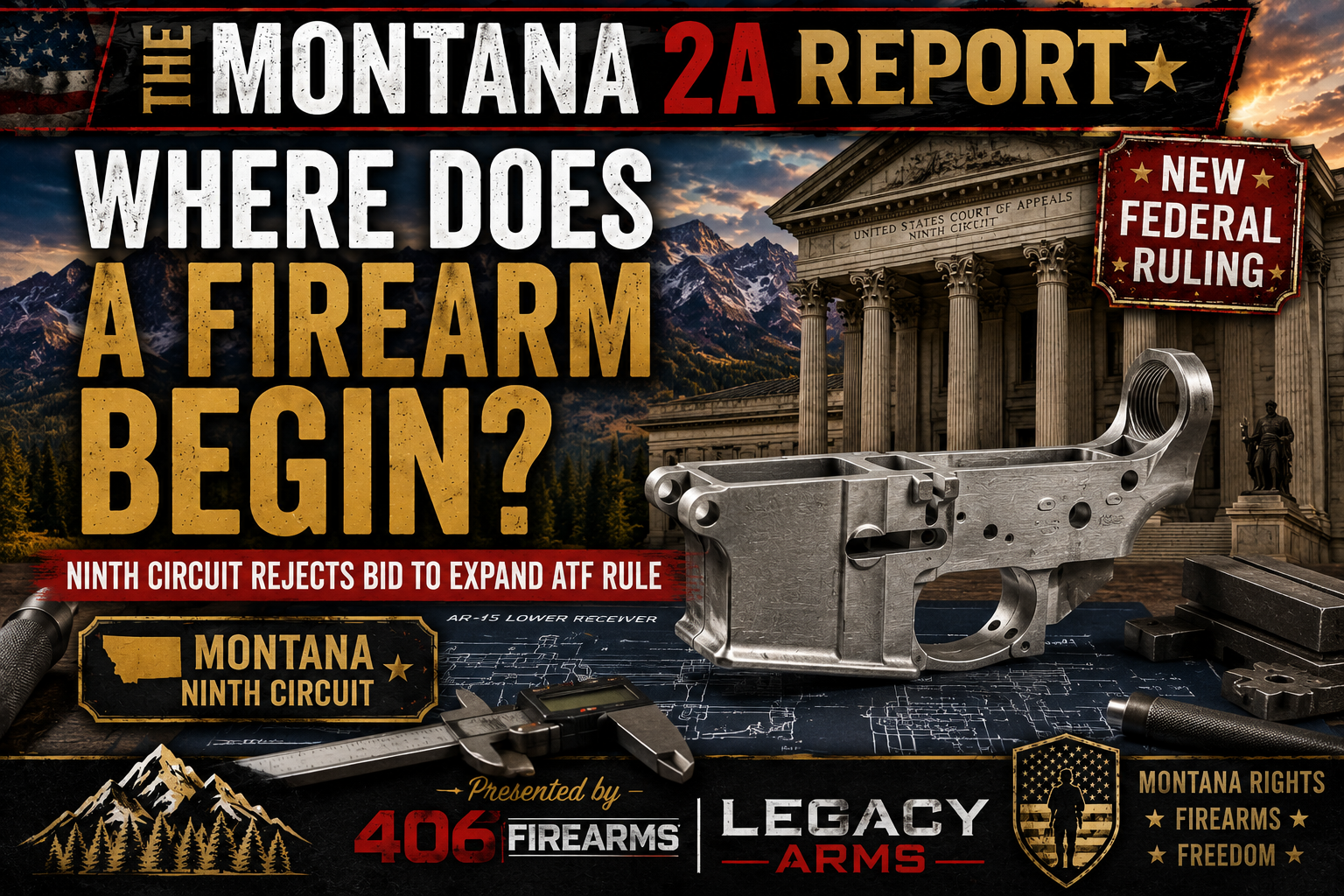
California Tried to Expand ATF's “Ghost Gun” Rule — The Ninth Circuit Just Said No
- Today is the first of the three catch-up editions we planned. I rechecked the August 21 Ninth Circuit decision before preparing this package. The controlling development remains intact: the Ninth Circuit unanimously vacated the lower-court judgment and ordered the challenge dismissed without prejudice for lack of Article III standing. Critically, the court did not decide the merits of ATF's rule or hold that all unfinished receivers are unregulated firearms components.
California Tried to Expand ATF’s “Ghost Gun” Rule — The Ninth Circuit Just Said No
The Montana 2A Report
Presented by 406 Firearms & Legacy Arms
August 25, 2026
Here’s a firearms case Montana gun owners should pay attention to for one very simple reason:
It came out of our federal appellate circuit.
On August 21, the U.S. Court of Appeals for the Ninth Circuit threw out a lawsuit brought by California and the Giffords Law Center challenging part of ATF’s federal frame-and-receiver regulation.
What makes this case unusual is that California and Giffords weren’t arguing that ATF had regulated too much.
They argued ATF hadn’t regulated enough.
They wanted a federal court to invalidate ATF’s treatment of certain unfinished AR-15-style receiver blanks that the agency says have not yet reached the point where they qualify as federally regulated receivers.
A unanimous three-judge Ninth Circuit panel rejected the lawsuit.
But the reason matters enormously.
The court ruled that the plaintiffs lacked constitutional standing. It did not rule that every so-called “80% receiver” is legal, unregulated or constitutionally protected.
That’s the difference between the actual decision and the headline that will inevitably make its way around social media.
What Exactly Was California Challenging?
The controversy centers on ATF’s 2022 Definition of “Frame or Receiver” and Identification of Firearms rule.
That regulation addresses when partially complete, disassembled or nonfunctional firearm frames and receivers can fall within the federal definition of a firearm.
One part of the regulation contains several examples illustrating where ATF believes that line should be drawn.
The important one here is Example 4.
ATF describes an AR-15-type billet or blank whose critical interior areas have not been indexed, machined or formed and which isn’t sold, distributed or possessed with instructions, jigs, templates, equipment or tools allowing it to be readily completed.
Under Example 4, that item is not a receiver for purposes of the federal regulation.
California and Giffords wanted that boundary invalidated.
They argued, essentially, that ATF had left too much unfinished material outside federal firearms regulation.
The Lower Court Agreed With Them
The plaintiffs initially won.
The federal district court concluded that Example 4 and related agency actions were unlawful, granted partial summary judgment for the challengers, and prevented ATF from relying upon that interpretation.
ATF appealed.
That put the dispute before the Ninth Circuit—the federal appellate court whose jurisdiction includes Montana, along with Alaska, Arizona, California, Hawaii, Idaho, Nevada, Oregon and Washington.
On August 21, the appellate court wiped out the plaintiffs’ victory.
Why Did the Ninth Circuit Throw the Case Out?
The answer is standing.
Article III of the Constitution limits federal courts to actual cases and controversies.
A plaintiff can’t simply disagree with government policy and ask a federal judge to rewrite it. The plaintiff generally must demonstrate an actual or imminent injury, show that the injury is fairly traceable to the challenged conduct, and show that the court can redress it.
California argued that insufficient federal regulation of unfinished receivers forced the state to spend additional money addressing firearms it characterized as ghost guns.
Giffords similarly argued that the policy interfered with its organizational mission and forced it to redirect resources.
The Ninth Circuit concluded that the evidence did not establish the necessary causal connection between Example 4 specifically and those alleged injuries.
California’s evidence addressed privately made or unserialized firearms more broadly but failed to adequately distinguish products affected by Example 4 from products already regulated under the federal rule.
The court therefore vacated the district court’s judgment and sent the case back with instructions to dismiss the challenge without prejudice for lack of standing.
“Without Prejudice” Is Important
That phrase deserves attention.
The Ninth Circuit didn’t permanently decide that nobody can ever challenge Example 4.
A dismissal without prejudice leaves open the possibility that another plaintiff—or potentially these plaintiffs with materially different evidence—could attempt another challenge.
More importantly, the Ninth Circuit never reached the underlying question of whether ATF’s interpretation of unfinished receivers is substantively correct.
So this decision is a meaningful procedural victory against this particular attempt to broaden the regulation.
It is not a final judicial declaration settling the federal status of every unfinished receiver.
What Is an “80% Receiver”?
Here’s another term worth cleaning up.
“80% receiver” is common industry language, but it isn’t a term defined in federal firearms statutes.
ATF itself says terms such as “80% receiver,” “80% finished,” “80% complete” and “unfinished receiver” aren’t statutory terms and aren’t terminology the agency officially endorses.
The legal question isn’t whether an object is mathematically 80% complete.
The question is whether the particular item has reached a stage where it meets the applicable statutory and regulatory definition of a firearm frame or receiver.
That is a much more fact-specific question.
And it’s one reason a person should be careful about treating every unfinished-looking piece of aluminum or polymer as legally identical.
So Are Receiver Blanks Legal?
Some are not regulated as firearms under the Gun Control Act.
ATF’s current public guidance says receiver blanks that do not meet the federal definition of a firearm aren’t subject to Gun Control Act regulation.
ATF gives as one example certain receiver blanks with a completely solid and unmachined fire-control cavity and without holes or dimples for the selector, trigger or hammer pins.
But that doesn’t mean every product marketed as an “80% lower” automatically falls outside federal regulation.
Configuration matters.
The degree of completion matters.
And under the existing regulation, whether an item is sold or possessed together with tools, jigs, templates, instructions or other material facilitating ready completion can matter as well.
What About the Supreme Court?
This is where another frequently misunderstood case enters the picture.
In 2025, the Supreme Court of the United States decided Bondi v. VanDerStok.
The Supreme Court held that the Gun Control Act’s statutory definition of a firearm is broad enough to encompass at least some weapon-parts kits and some partially complete frames or receivers.
That decision rejected the argument that ATF categorically lacked statutory authority to regulate those products.
But it didn’t mean that every piece of raw material that could someday become a receiver automatically becomes a federally regulated firearm.
The line still has to be drawn somewhere.
And Example 4 is one place ATF currently draws it.
The Ninth Circuit’s August 21 decision leaves that particular interpretation standing because the plaintiffs challenging it failed to establish standing.
Why This Matters in Montana
Montana is within the Ninth Circuit.
That alone makes this more relevant here than another firearms case coming out of a distant federal circuit.
But the practical takeaway needs to remain precise.
The Ninth Circuit did not announce:
“80% lowers are legal in Montana.”
It did not invalidate ATF’s entire frame-and-receiver regulation.
It did not eliminate federal serialization requirements for items that actually qualify as regulated firearms.
It did not authorize prohibited persons to possess firearms.
And it did not eliminate federal licensing requirements applicable to somebody engaged in the business of manufacturing firearms.
What it did was stop California and Giffords, on the evidence they presented, from using this lawsuit to force ATF to regulate further.
That’s significant.
It’s just narrower than some headlines will make it sound.
Privately Making a Firearm Is Not the Same as Manufacturing Firearms for Business
This distinction is especially important for Montana gunsmiths and FFLs.
Federal firearms law has historically distinguished between an individual making a firearm for lawful personal use and somebody engaged in the business of manufacturing firearms for sale or distribution.
Those activities don’t carry the same federal requirements.
The moment a commercial firearms business becomes involved, additional licensing, marking, recordkeeping and transfer requirements can enter the picture.
FFLs accepting privately made firearms into inventory can also face specific marking and recordkeeping obligations.
And the National Firearms Act remains an entirely separate concern if the firearm being made falls into an NFA-regulated category.
The Ninth Circuit ruling changed none of that.
The Larger Question: Who Draws the Line?
Strip away the emotionally loaded phrase “ghost gun,” and this case raises a fascinating legal question.
At some point, a block of aluminum is unquestionably just a block of aluminum.
At another point, enough machining has occurred that the object is unquestionably a firearm receiver.
Where between those two points does federal firearm regulation begin?
And perhaps even more importantly:
Who gets to decide?
Congress writes federal statutes.
Administrative agencies interpret and enforce them.
Courts determine whether those interpretations remain within the law and the Constitution.
That tension is at the center of an enormous amount of modern firearms litigation.
The more an administrative agency attempts to regulate objects approaching—but not yet clearly crossing—a statutory definition, the more important those boundaries become.
The Terminology Can Distort the Debate
“Ghost gun” is an effective political phrase because it immediately creates an image of something sinister and untraceable.
But it can also collapse several legally distinct things into one category.
An unfinished receiver blank isn’t necessarily a firearm.
A privately manufactured firearm isn’t necessarily an illegally manufactured firearm.
An unserialized privately made firearm isn’t automatically contraband under federal law merely because it lacks a commercially applied serial number.
And a commercially manufactured firearm subject to federal marking requirements is an entirely different legal category.
Those distinctions matter.
Especially when criminal liability can depend on them.
What Montana Gun Owners Should Do
For the average Montana gun owner, the August 21 decision requires no immediate action.
But if you’re buying an unfinished receiver, completing a firearm for personal use, performing gunsmithing work involving privately made firearms, operating as an FFL or manufacturing firearms commercially, don’t base your decisions on a meme declaring that the Ninth Circuit “legalized 80% lowers.”
It didn’t.
Determine exactly what the item is.
Determine its current federal classification.
Understand whether your activity is personal or commercial.
Understand any applicable marking and recordkeeping requirements.
And if the project involves an NFA configuration, stop and determine those requirements before manufacturing anything.
The cost of getting that analysis wrong can be considerably higher than the cost of getting competent advice first.
The Bottom Line
The Ninth Circuit handed California and Giffords a defeat in their attempt to force broader federal regulation of certain unfinished AR-style receiver blanks.
For gun-rights advocates, that’s a meaningful development—particularly because it happened in the federal circuit that includes Montana.
But accuracy matters.
The court decided standing.
It did not decide that every unfinished receiver is constitutionally protected.
It did not erase ATF’s frame-and-receiver rule.
And it did not create a federal free-for-all for privately manufactured firearms.
What the decision does preserve, at least for now, is a federal regulatory line recognizing that there remains a point at which unfinished material has not yet become a firearm receiver.
That boundary is worth defending.
And it’s worth understanding correctly.
We’ll keep watching what happens next.
Montana Rights • Firearms • Freedom.
From Military Service to Montana — A Continuing Commitment to the Constitution.
The Montana 2A Report is presented by 406 Firearms & Legacy Arms — Veteran Owned • 24 Years of Military Service • 500 Thirsty Lake Rd, Rexford, MT 59930.
Current Sources
Ninth Circuit — State of California v. U.S. Bureau of ATF, August 21, 2026 opinion
ATF — Receiver Blank Questions and Answers
ATF — Current Receiver Blank Guidance
ATF — Current 27 CFR Part 478 Regulations
Reuters — Ninth Circuit Decision, August 21, 2026
Legal Disclaimer: This article is provided for general informational purposes only and does not constitute legal advice. Federal and state firearms laws, regulations and agency interpretations can change, and the legal classification of a particular receiver, component, firearm or manufacturing activity depends upon specific facts. Firearm owners, builders, gunsmiths, manufacturers and FFLs should verify current law and obtain qualified legal advice when appropriate before acting.
Montana 2A, Ninth Circuit, ATF, Unfinished Receivers, Receiver Blanks, Privately Made Firearms, PMF, Ghost Guns, AR-15, Federal Firearms Law, Second Amendment, Montana Gun Owners, Gunsmithing, FFL, 406 Firearms, Legacy Arms